Search

naramata-blend

Life in a slow place that quickly steals your heart.

Category

Uncategorized

English Channel Relay III

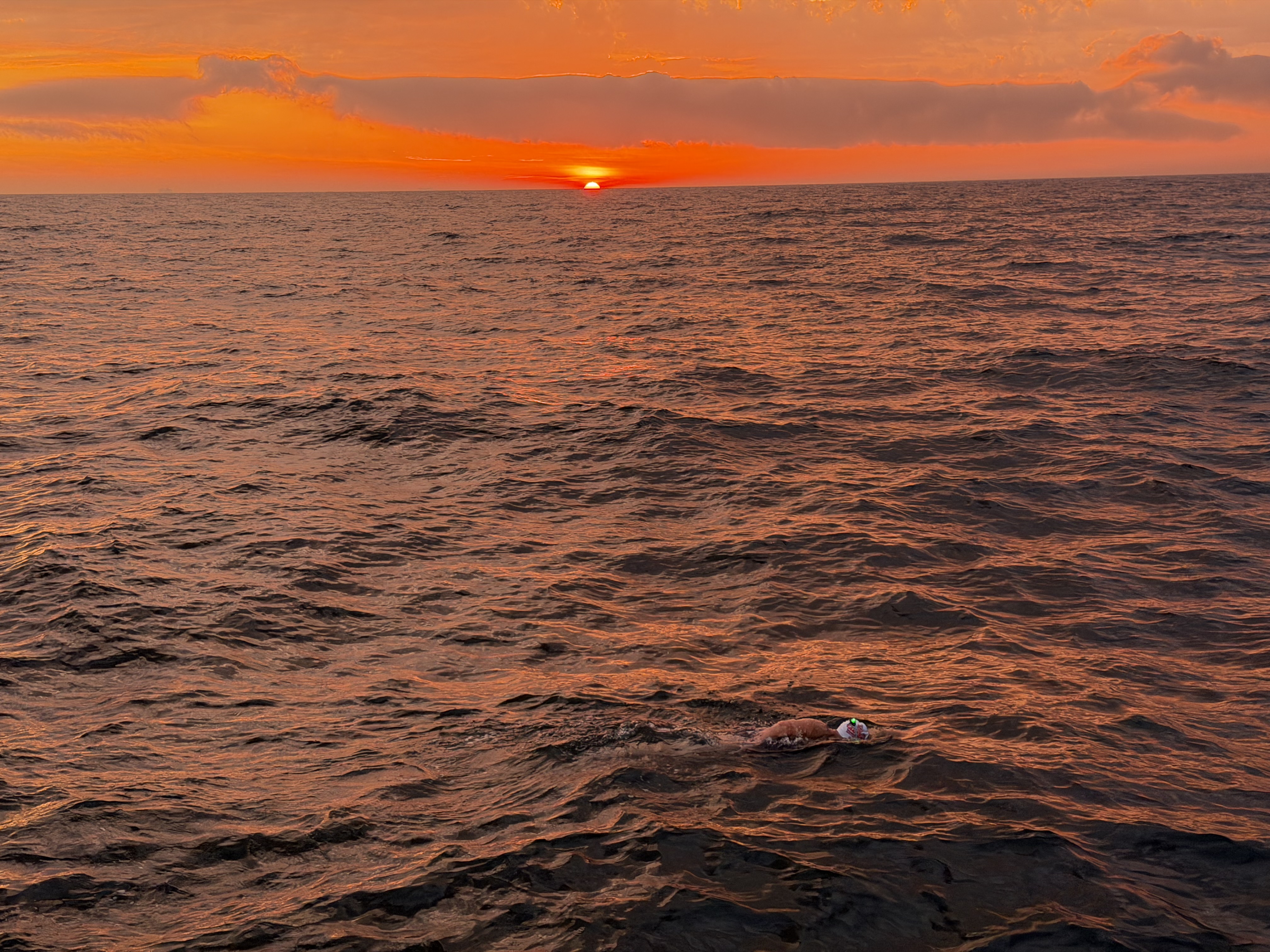
A swimmer wearing a colorful cap glides through ocean waters at sunset, with vibrant orange and yellow hues lighting up the sky.

This is why I’m doing this. This moment captured in Al’s photo. I’m swimming in the English Channel with three other tough women and this right here, right now, is the most beautiful sunrise I have ever seen. I breath on my right and I see husband Al standing guard on the boat. I notice for the first time Anastasia’s happy face on her side. I breath to my left and I see an infinite horizon, ocean waves and intense orange.
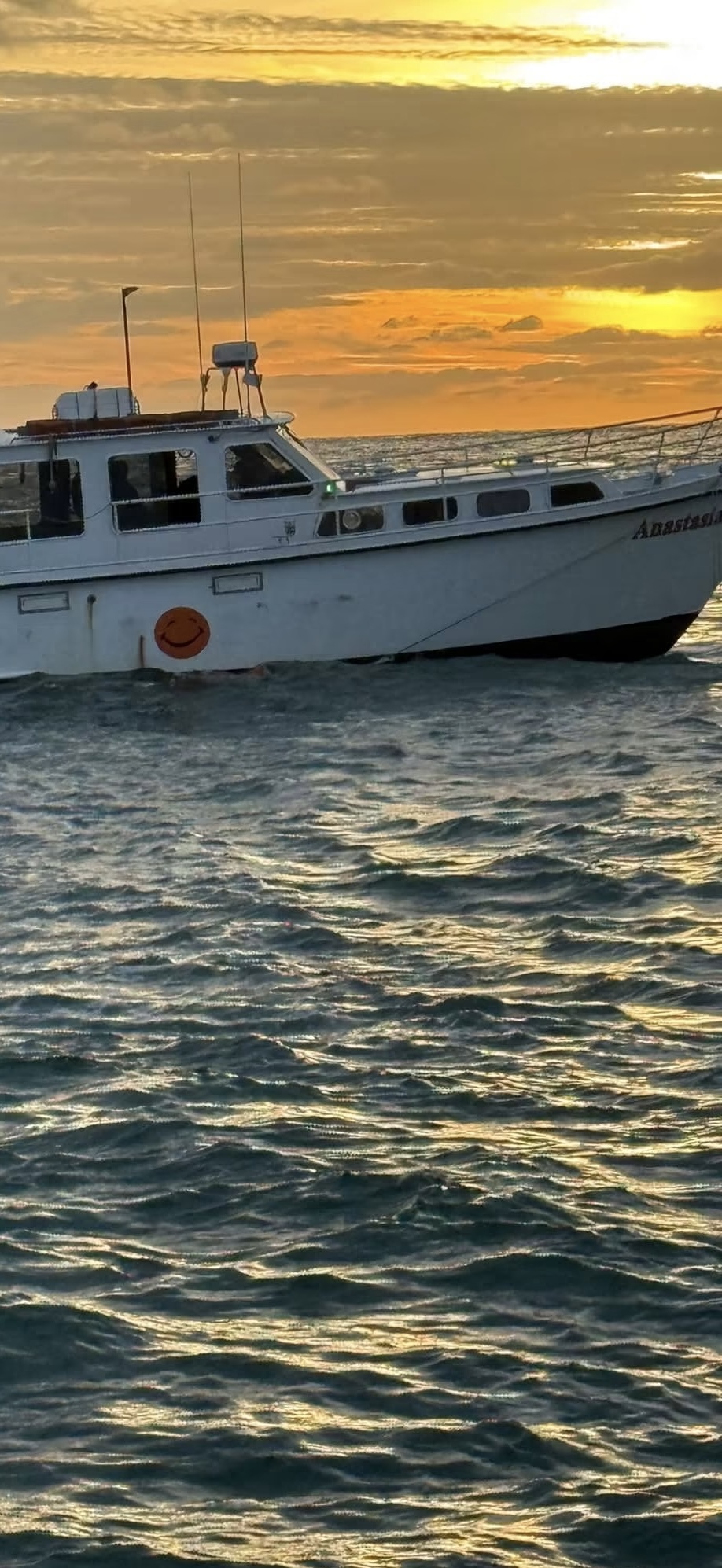
A boat named 'Anastasia' sailing on shimmering water during sunset, with waves reflecting shades of orange and gold in the background.

Just as teammate Dionne said, “It will get better when the sun comes up.” It sure did.

It was no waiting “Dovercoaster” for team Crazy Canucks III. One of the biggest hurdles for a successful Channel crossing is getting to swim at all. Our 10-day tide window began August 26, 2026 at midnight. The boat pilot, Rob, has to make the call if the weather will be good enough for a crossing. This endeavour was three years in the making as that’s how long ahead you need to secure your boat which costs roughly $6,000. It’s relay teams have more latitude to swim in more challenging conditions than solo swimmers can tackle and we got challenging. In fact, we were the only boat that went out at all in our 10 day window. (If we hadn’t gone that night in these pretty awful conditions we would have gone home without dipping a toe in the Channel at all.) Rob decided to assemble us two hours before our midnight window for our attempt as the forecast for the next 10 days was impossibly high winds.
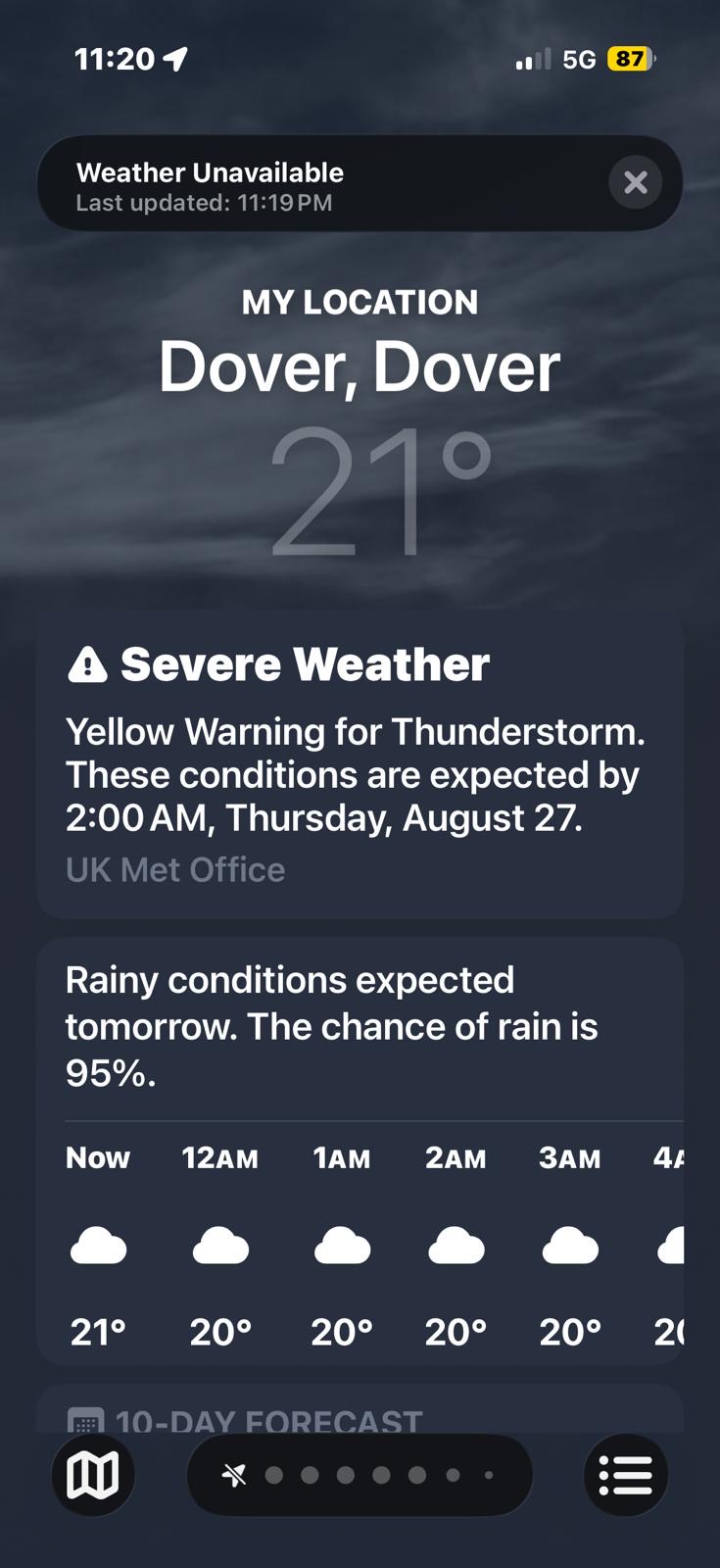
Weather forecast for Dover showing a temperature of 21°C and a severe thunderstorm warning for August 27. Rainy conditions expected tomorrow with a 95% chance of rain.

Me and my support guys Al and brother-in-law Stirling had to get an emergency tire replacement on our rental car and drive all day from Yorkshire to Dover making it with hours to spare. Deb was still in Canada when Rob phoned Monday to tell us we were a go Wednesday at 10 p.m. Tina and her sister Janet were freshly arrived in the jet lag fog and Dionne had just made it to Dover. The stars aligned imperfectly but we assembled at the harbour for the traditional nervous smiles photo as we pooled our 1,500 british pounds in cash to hand over to Rob and double-checked our passports. “Stick with me,” triple crown swimmer Deb says. “I have gone at the beginning of my window every Channel swim I’ve done.”
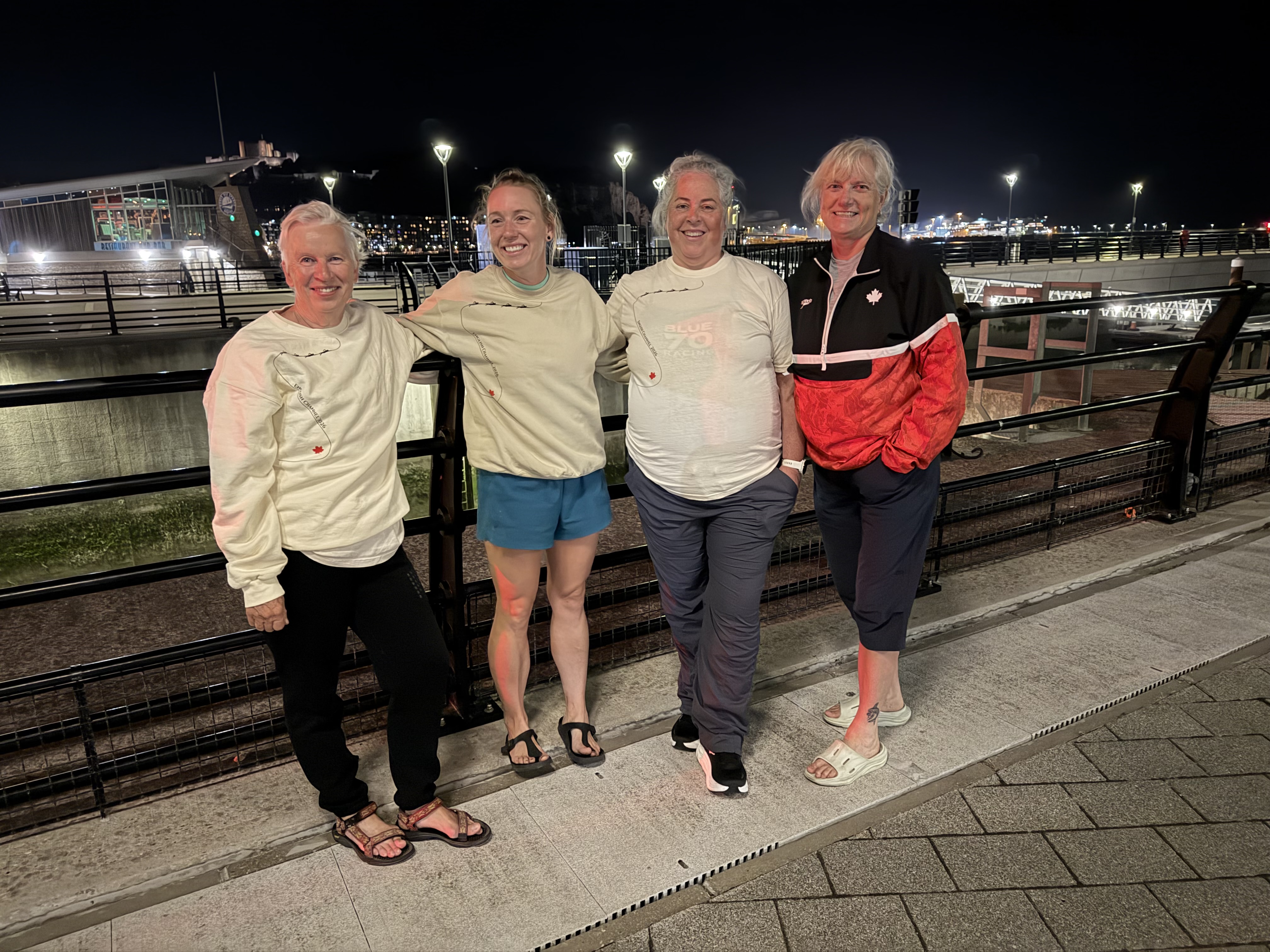
Four women posing for a photo at night near a waterfront, wearing casual clothing including sweatshirts and shorts, with city lights in the background.

Elaine, Dionne, Deb and Tina

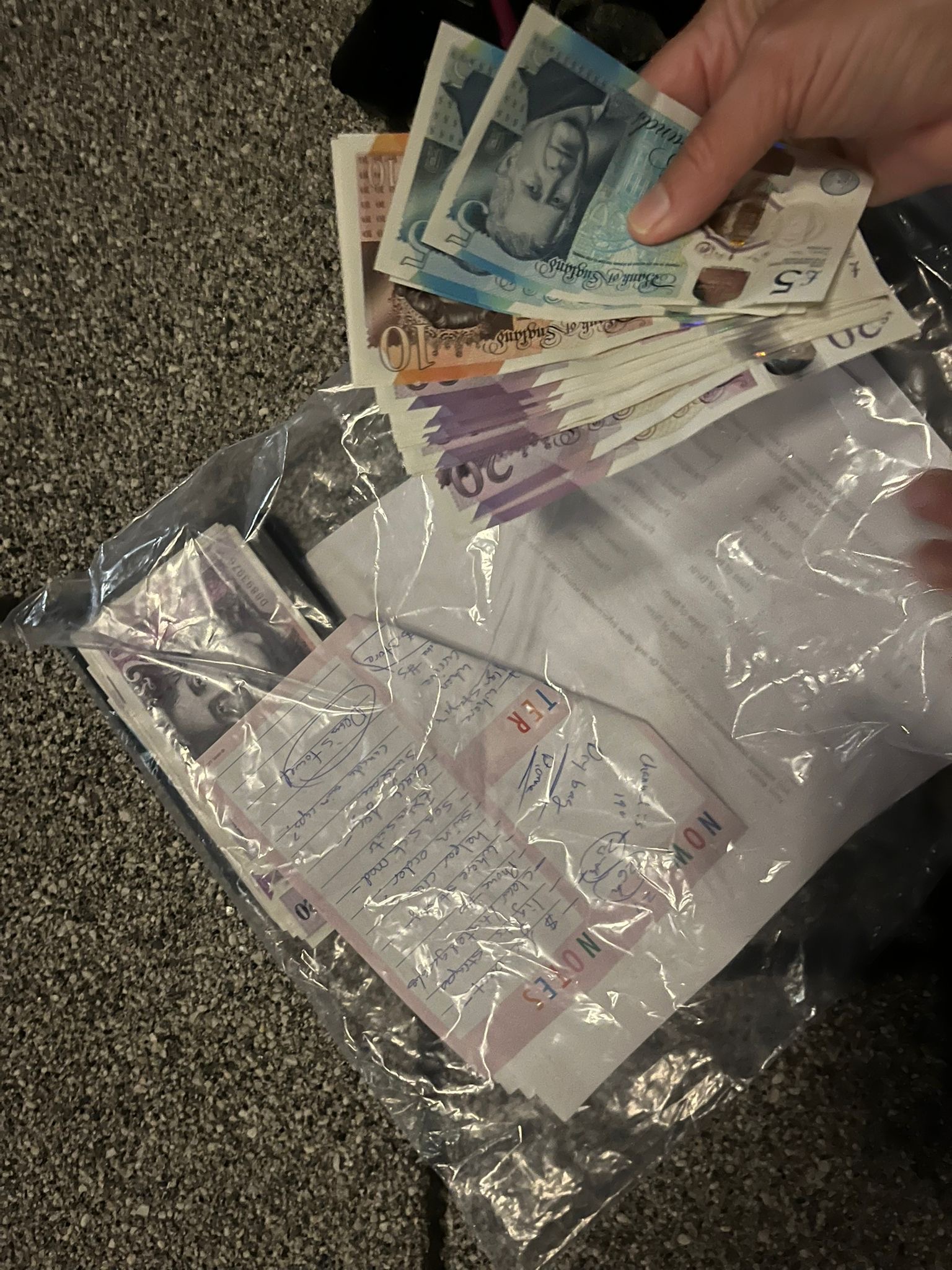
A hand holding various banknotes while other notes and documents are visible inside a clear plastic bag on a textured surface.

Dionne joked that we were meeting in the dark to make a drug deal. We did have drugs, seasick medications, but more on that later.
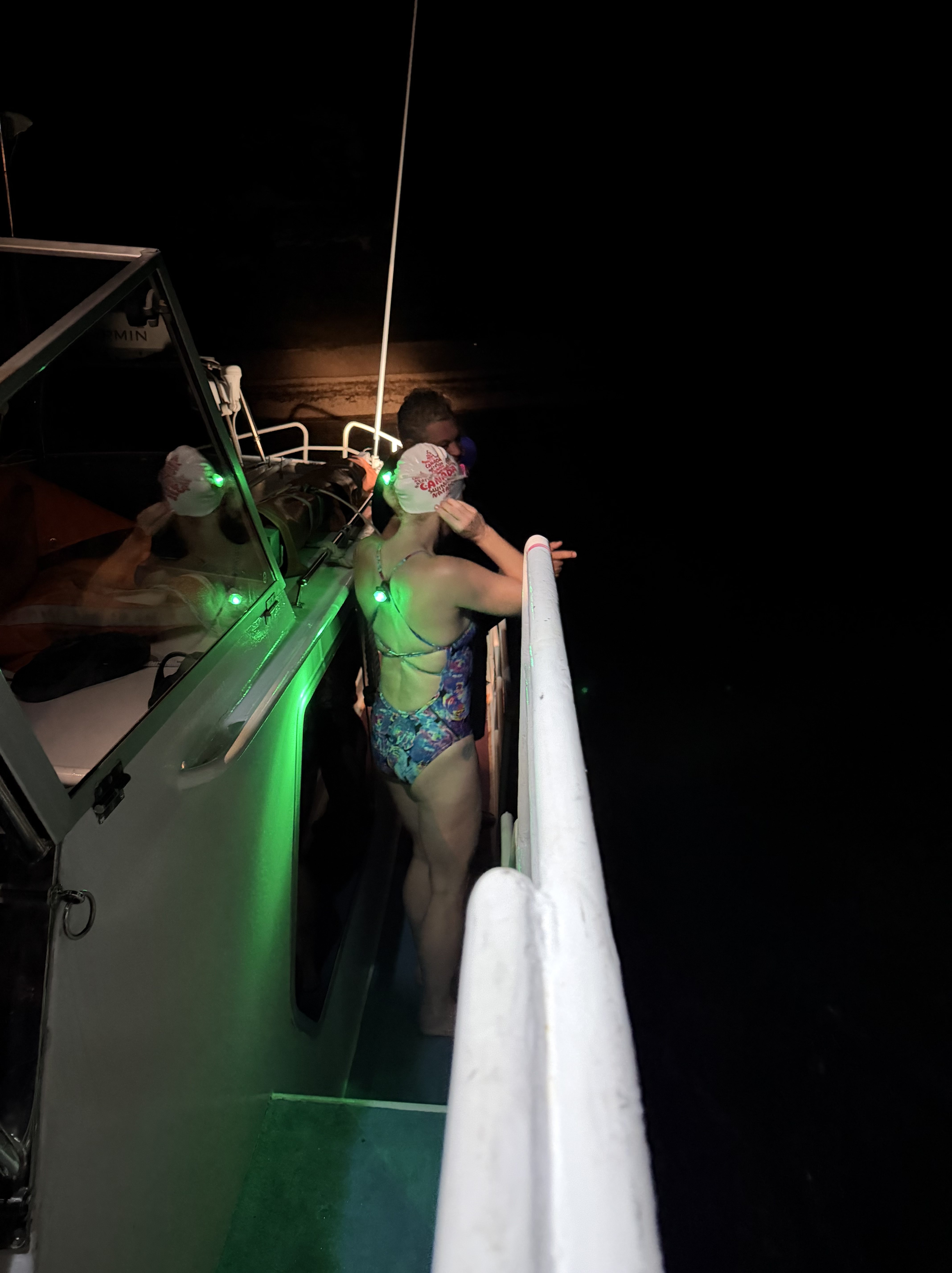
A person in a colorful swimsuit and swim cap stands on the edge of a boat at night, illuminated by green lights, gazing at the water.
And Dionne is off to swim to the beach at Samphire Hoe.

“My memories are not glamorous and I don’t think recounting them expresses the emotion quite right 😂,” says Dionne. “The swimming was what I expected; I’m pretty comfy in rough water and I love a bit of a bouncy challenge in the water. But I did learn that I don’t love a bouncy challenge on a boat!!!”
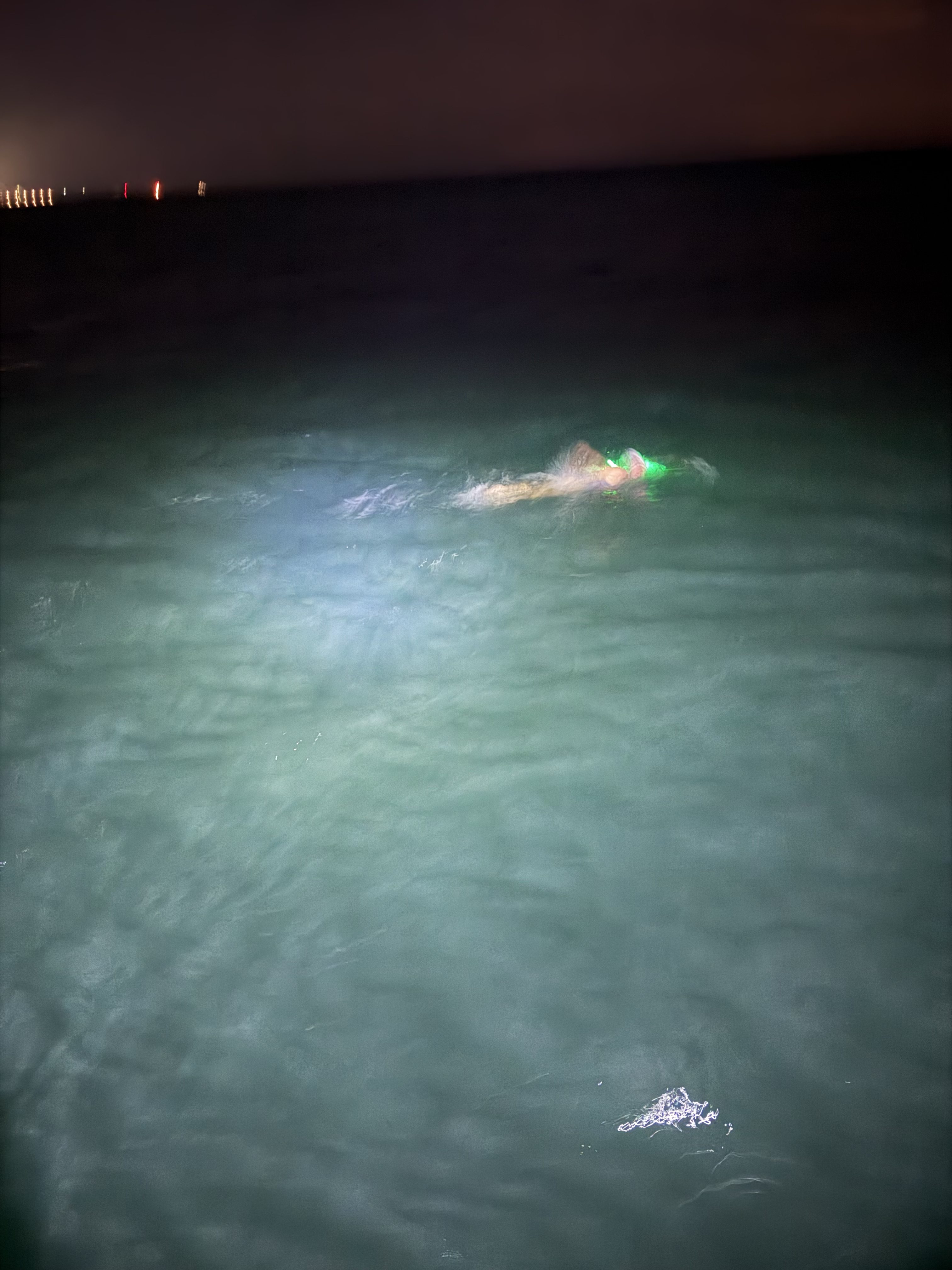
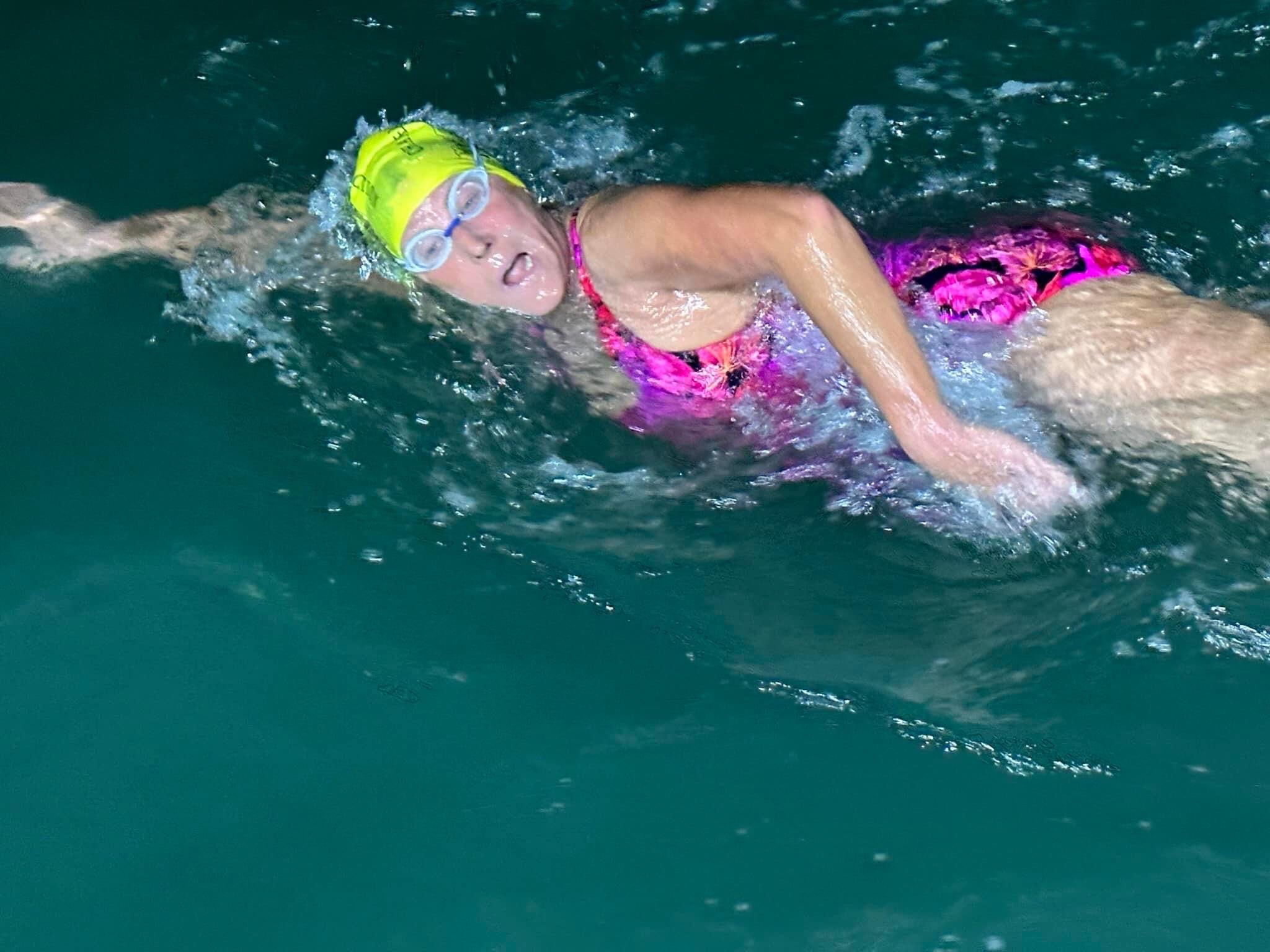
A person swimming in dark waters at night, illuminated by a light source, with faint city lights visible in the background.

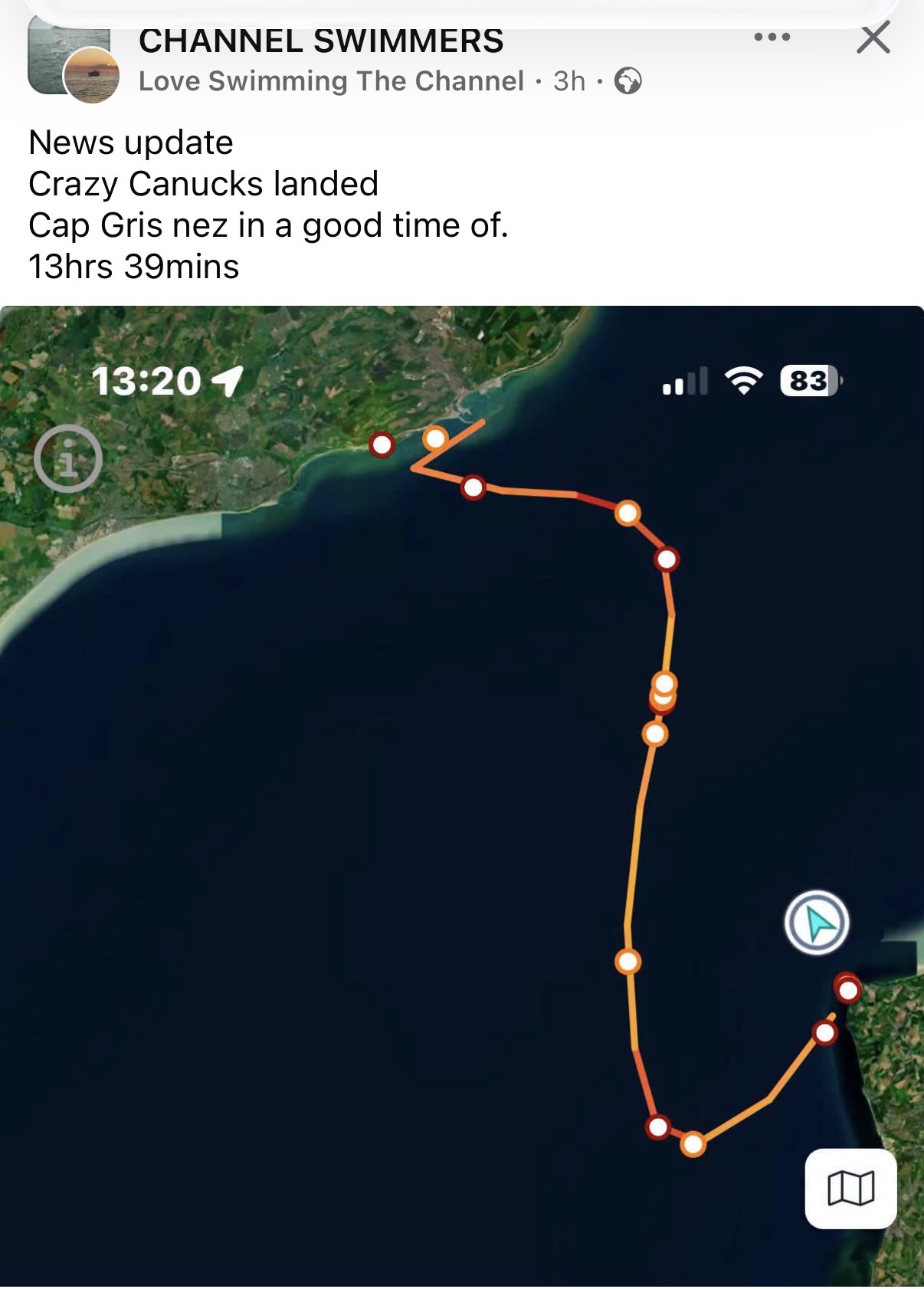
Dionne put in a fast first leg in relatively calm seas. Then… she got back on the boat and became very seasick. A pattern that persisted for all but the last two or three hours of the 13 hour and 39 minute Crazy Canucks III relay. Dionne and Tina were both affected to various degrees despite various seasick meds as was poor Janet, who came along as support. “I love my sister, but never again,” she says.

“It was such an odd mix of emotions, because I was SO sick, but I was also terrified of having to quit the swim (first because of how sick I was, and then later because of the weather) and deal with the disappointment of that. It was a funny pull of emotions, and really, it all just gets filed under the “type II” fun folder, and is a pretty hilarious story in the end! I loved our team, and I REALLY liked our training swims last fall. I remember going into work after our qualifier and telling my students what I had done that morning and they didn’t quite know how to respond! There was just so much fun stuff around it all! Thank you Elaine for organizing us (that was WONDERFUL), and Tina and Deb for being such amazing teammates as well. It was a wonderful, wonderful experience that I won’t forget anytime soon :)”
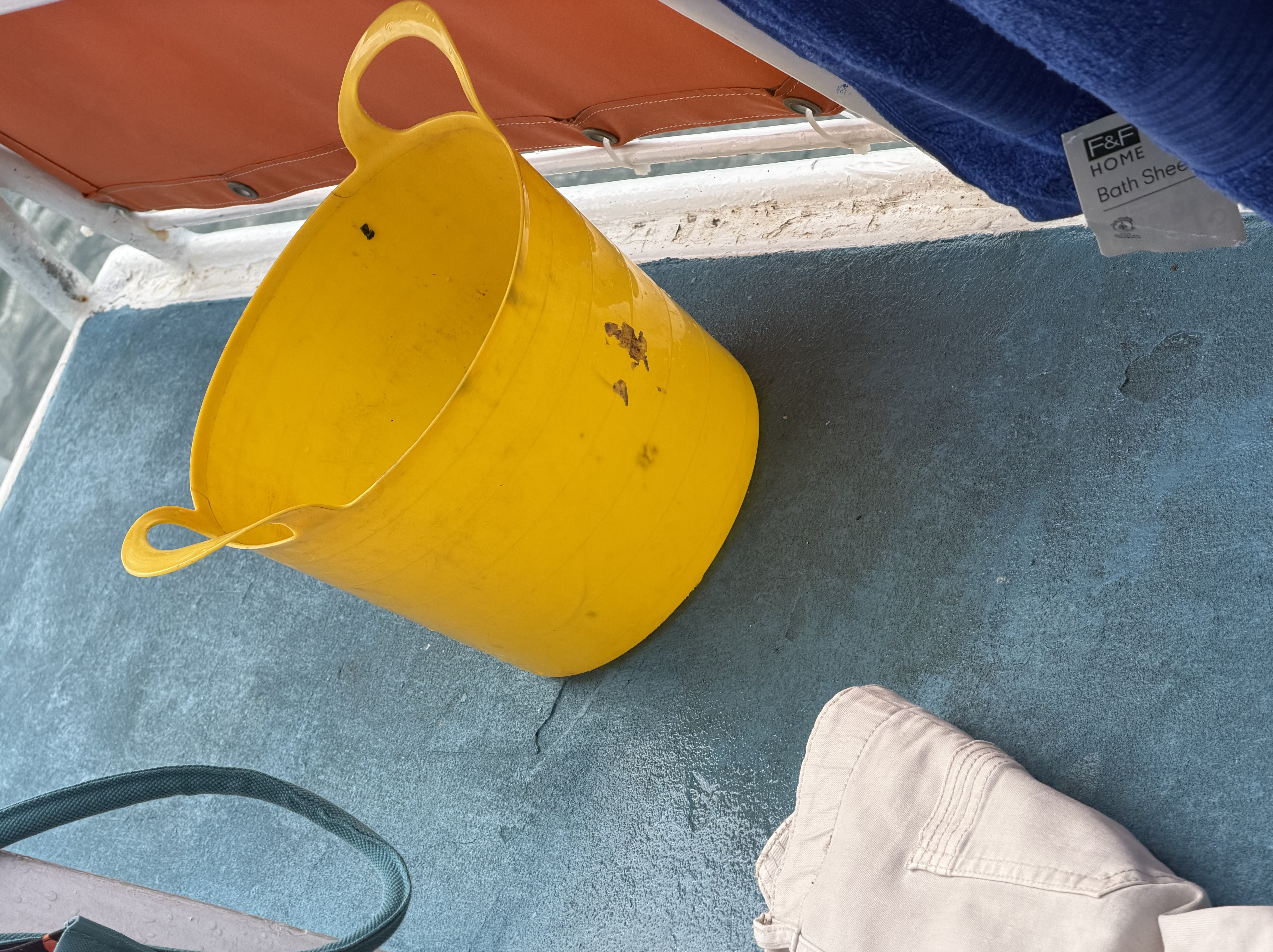
A yellow plastic bucket sitting on a gray surface, with a pair of beige pants partially visible nearby.

This yellow bucket had a lot of use. Sometimes by multiple people simultaneously. Seasickness is one of the biggest and most miserable challenges of an English Channel relay swim, caused by hours of waiting on a slow, bouncy support boat.The conditions of our swim were particularly challenging as the disorganized waves were bouncing the boat both sideways and front to back. Even our observer (there from the Channel Swimming and Piloting Federation to verify we followed all the rules to make our swim official) succumbed for the first time on a crossing. Luckily Dionne and Tina felt better in the water. It’s often what ends a relay. In our case, these brave women simply toughed it out. On one of Dionne’s turns she had to pause the observer’s countdown to the relay changeover a few seconds to visit the yellow bucket.

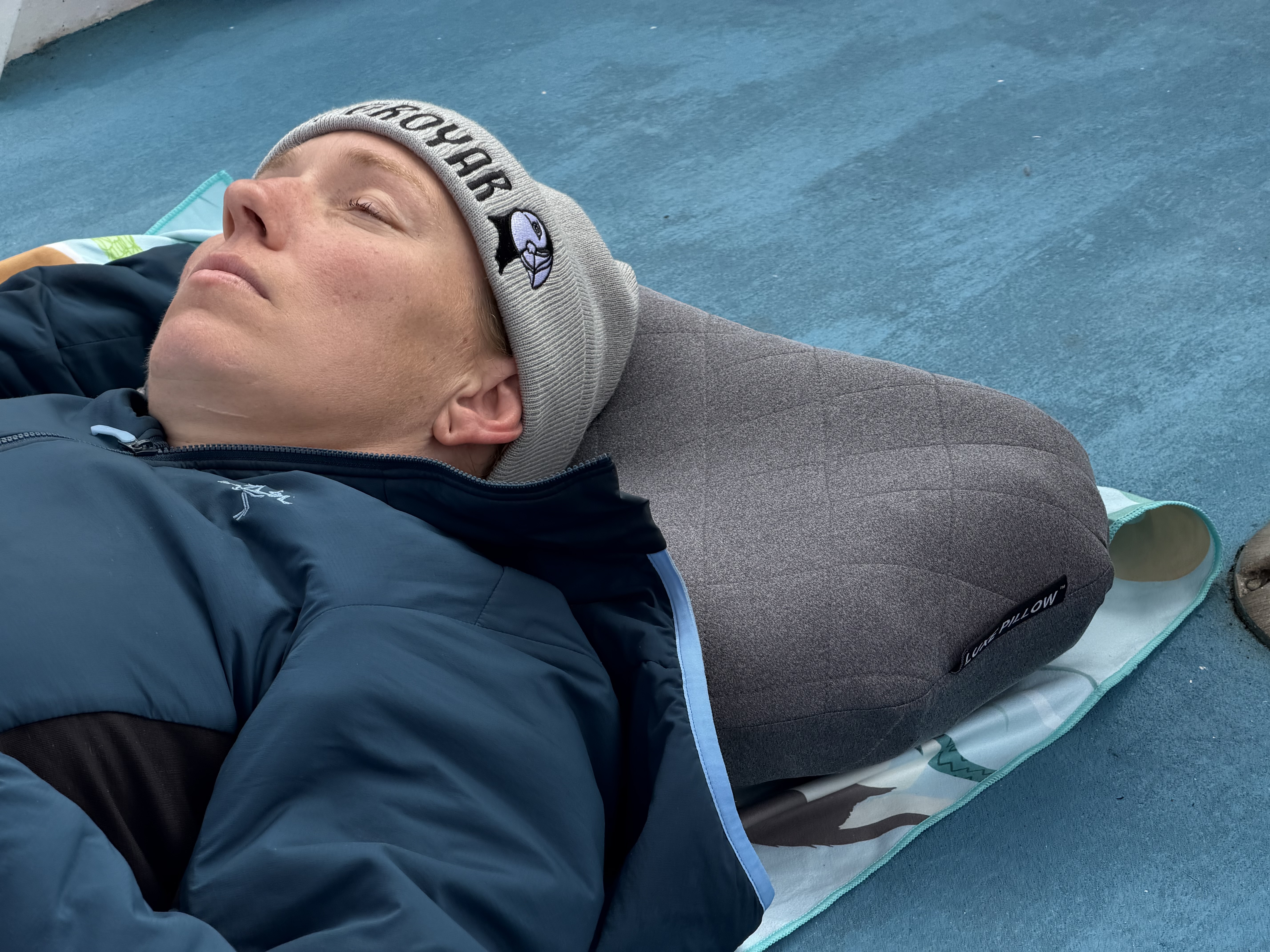
A person resting on a blue surface, wearing a winter hat and a jacket, with a large gray pillow positioned behind their head.
Poor brave Dionne

Tina, up next had a tough first shift trying to stay with the boat in the pitch dark and the increasingly bumpy conditions.

“The whole experience was more than I thought it would be,” says Tina. “Not that I hadn’t thought it through but the swimming was harder than I thought (at times) and being on the boat was harder than I thought.”

Tina says, “My first swim was especially hard. It was at night, very dark. I didn’t realize until my second swim that the hull of the boat was white and once the sun came up on my second shift quite easy to see even with only a slight amount of light. In my first swim, I struggled to keep my line next to the boat. I could see the lights on the boat, but would have to stop or sight to see the angle that the boat was headed. It took more effort than I thought it would and I should have bought new goggles.”

She goes on to say that it was rougher than she had imagined in the Channel. “After my first swim, when I could sort of see the boat, the rough water didn’t bother me. I got tossed around, but as long as I was on top of the water, being tossed was fine. Each of my legs of swimming felt stronger. I was just hitting my stride when it was over.”

Like Dionne, Tina said the toughest part was the boat hours. “I knew seasickness was a possibility but I hadn’t accounted for the fatigue of staying up through the night, plus taking care of myself to not get sick and to sleep until it was my turn again. And the swimming, it just kept getting better throughout the event.”
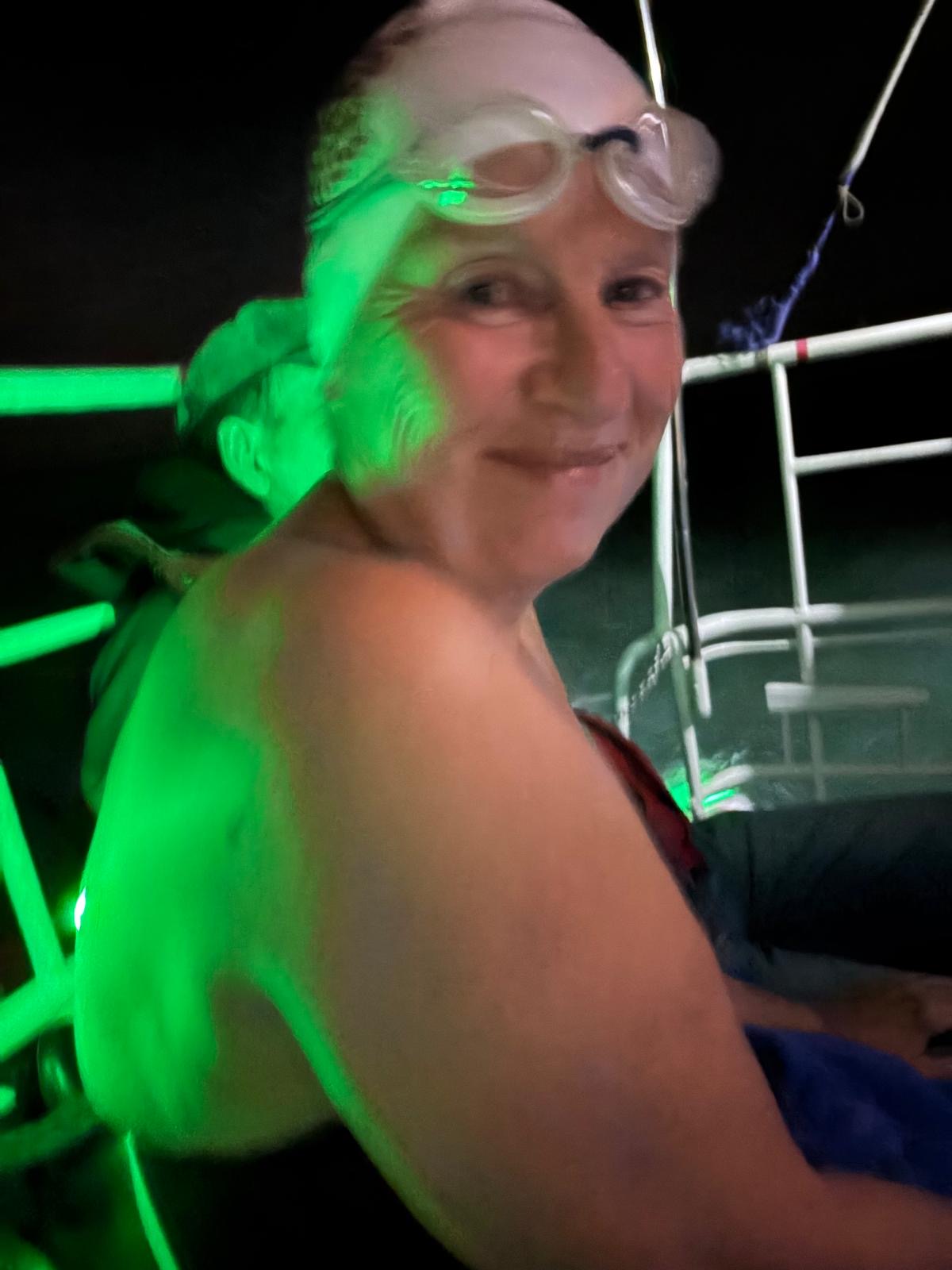
A smiling woman wearing swimming goggles and a swim cap, sitting on a boat with green ambient lighting.

Green lights ready to go. Watching Tina I’m seeing her discomfort out there and am thinking to myself, “I’ll be alright. I’ve done this before lots.” I quickly realized keeping in close contact with the boat was going to be tough and I was struggling. When the Anastasia keeled over drastically in the waves it took the spotlight trained on me with it. At one point the co-captain Gary blew a whistle to get my attention as I was heading off to Belgium. Deb on her turn figured out to just breath on one side to always keep the boat in sight. I did my usual pattern and got swept off regularly. The waves were disorganized and unusually for me, I swallowed some pretty good gulps of seawater. On the bright side, the concentration involved made the hour seem fairly short. Once on the ladder at the end of my turn I said, “Well that was pretty rough.” Rob, from far inside the cockpit replied gruffly, “There is nothing wrong with these conditions.” Ok then this requires some sucking it up I guess and no negative comments.

Once back on board I took in a scene like Armageddon. Bodies strewn all over the deck trying to recover and others making use of the yellow bucket. I told the team there was no shame in quitting if it was all too much. I rather over-dramatically declared no one needs to die. I earned some ribbing for this in the debrief. Fair enough.

There were no takers on my out and we carried on and no-one came close to dying.

Stalwart Deb, who has swum the Channel solo along with Catalina and New York making her one of only 400 in the world to do so, handled her turn and every subsequent turn with equanimity. She did remark that it was some of the toughest conditions she had swum in which oddly helped my morale. (Look for a three-part docu series coming out about her remarkable achievements called I Am An Athlete.)

“We had everything short of snow,” says Deb. “We had wind, rain, lightning, sun, jellyfish (wait that’s not weather, but there were SO MANY jellies. I was a little skeptical when we left just before midnight and it was a rough ROUGH night. I’m super proud of my teammates for toughing it out through the conditions. Three out of three crossings I’ve done have all been ahead of the planned window, so if you want to swim early just bring me along.”
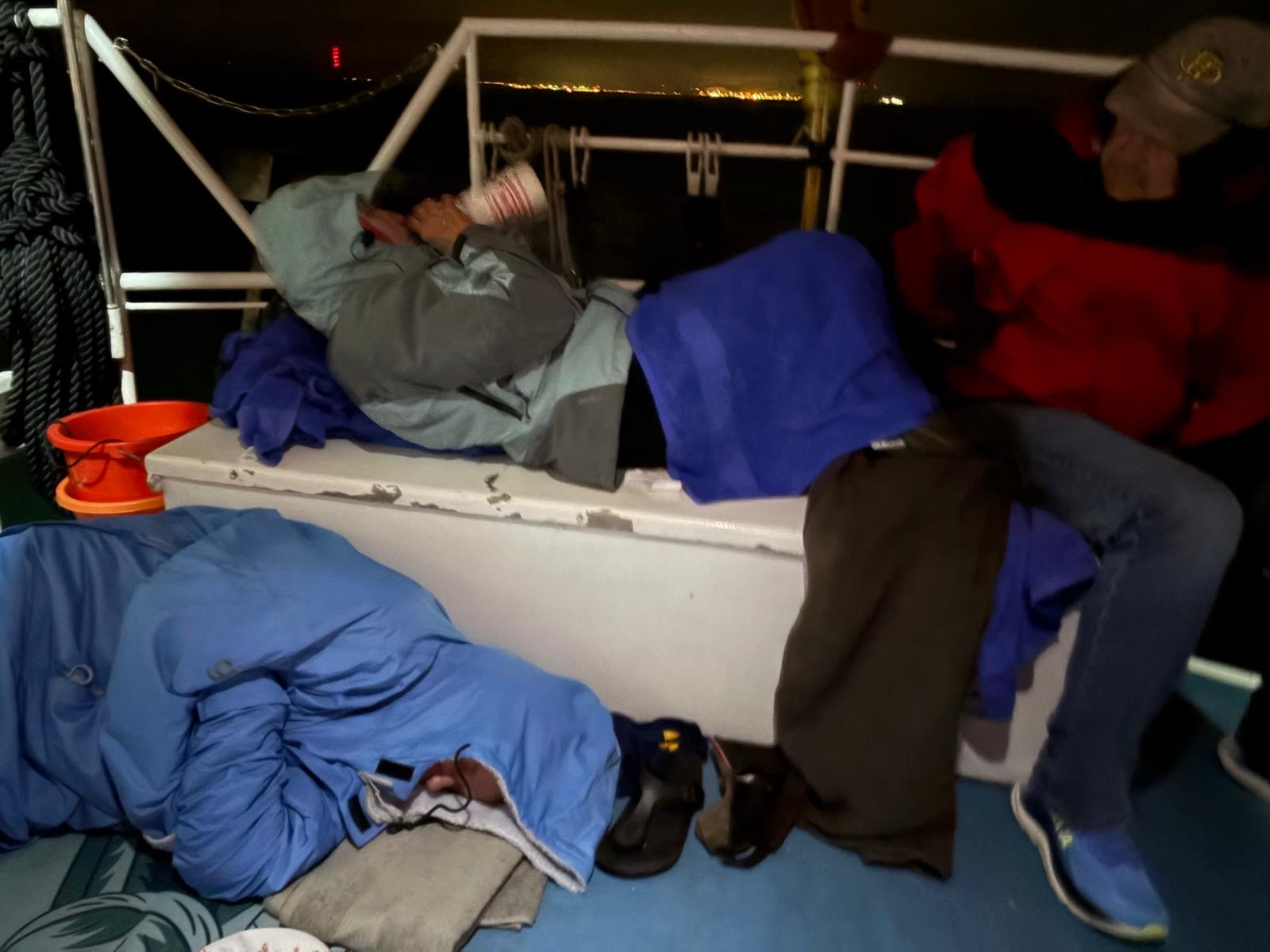
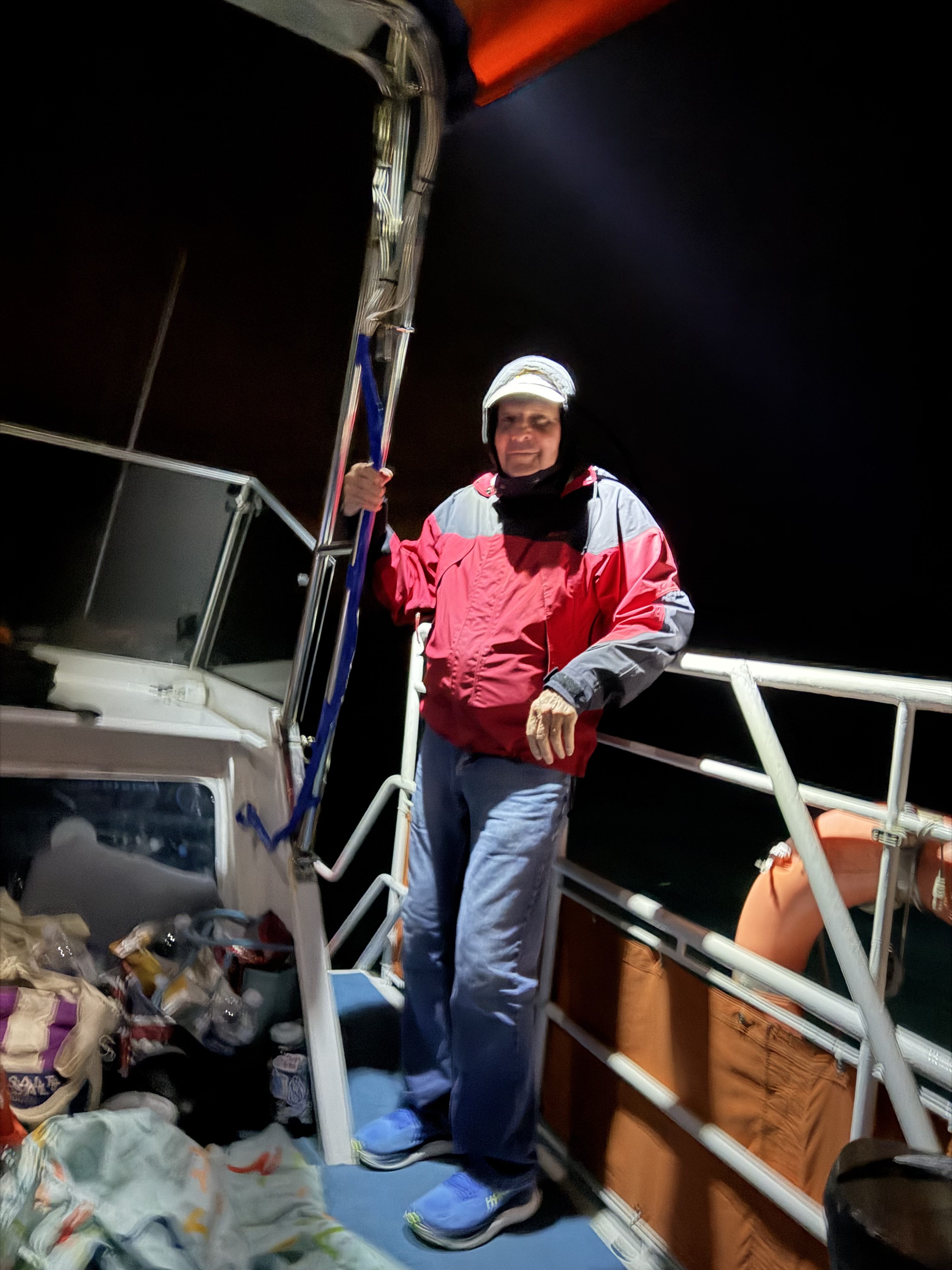
Two individuals resting on a boat at night, one sitting on a cooler wearing a red jacket and a cap, while another is lying down wrapped in blue blankets.
Carnage on the boat

At one point the sky was lit up with lightning strikes in the distance. We all kept a careful eye out. If they had come much closer Rob would have had to call off the swim. We watched and whispered to each other hoping for the best. By this point we had suffered too much to give it all up.
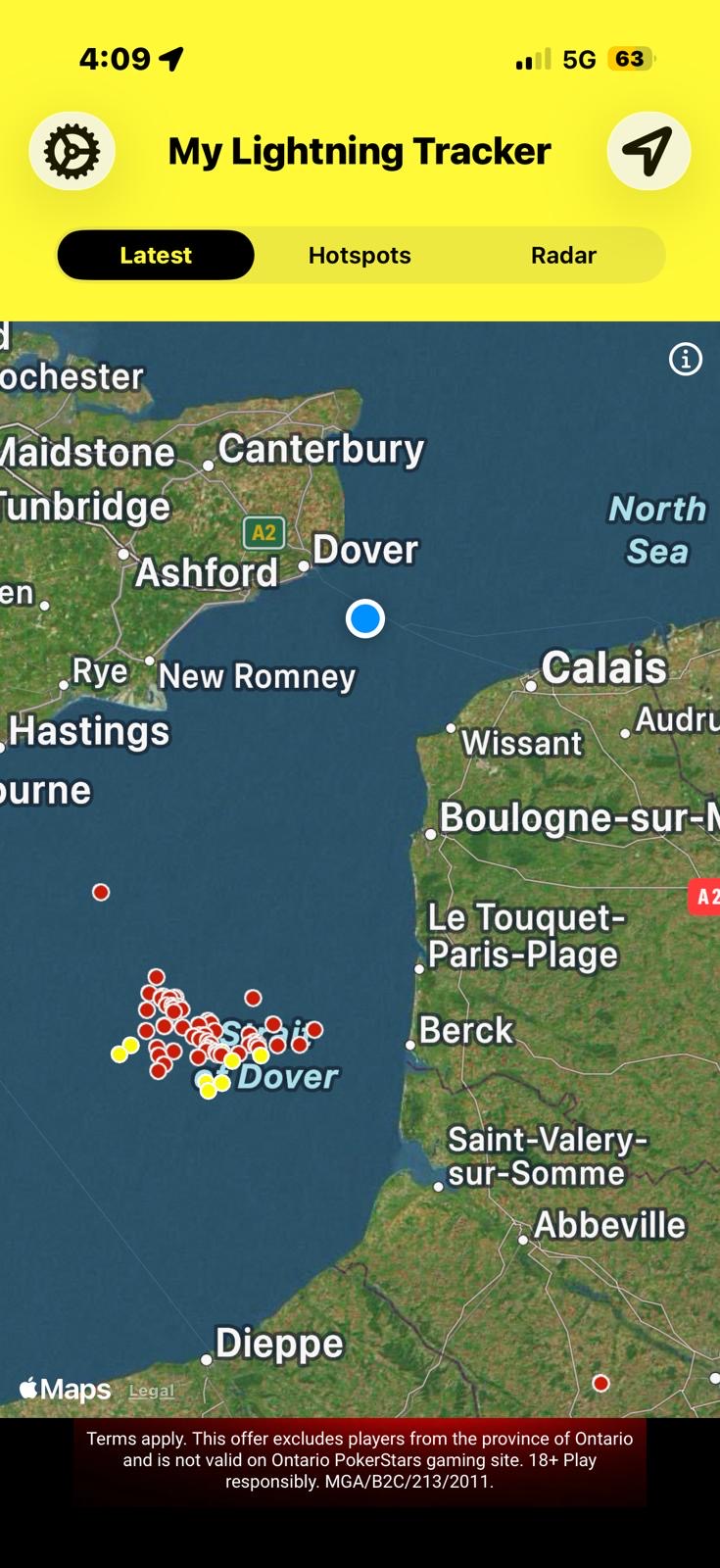
Map showing the My Lightning Tracker application with a focus on the Dover area and surrounding seas, highlighting lightning strike locations in red and yellow.

Dionne had a second swim in the dark in the worsening conditions and came out talking about it. “In my head I’m like I’m never doing this again. I’m never even swimming again,” she said.
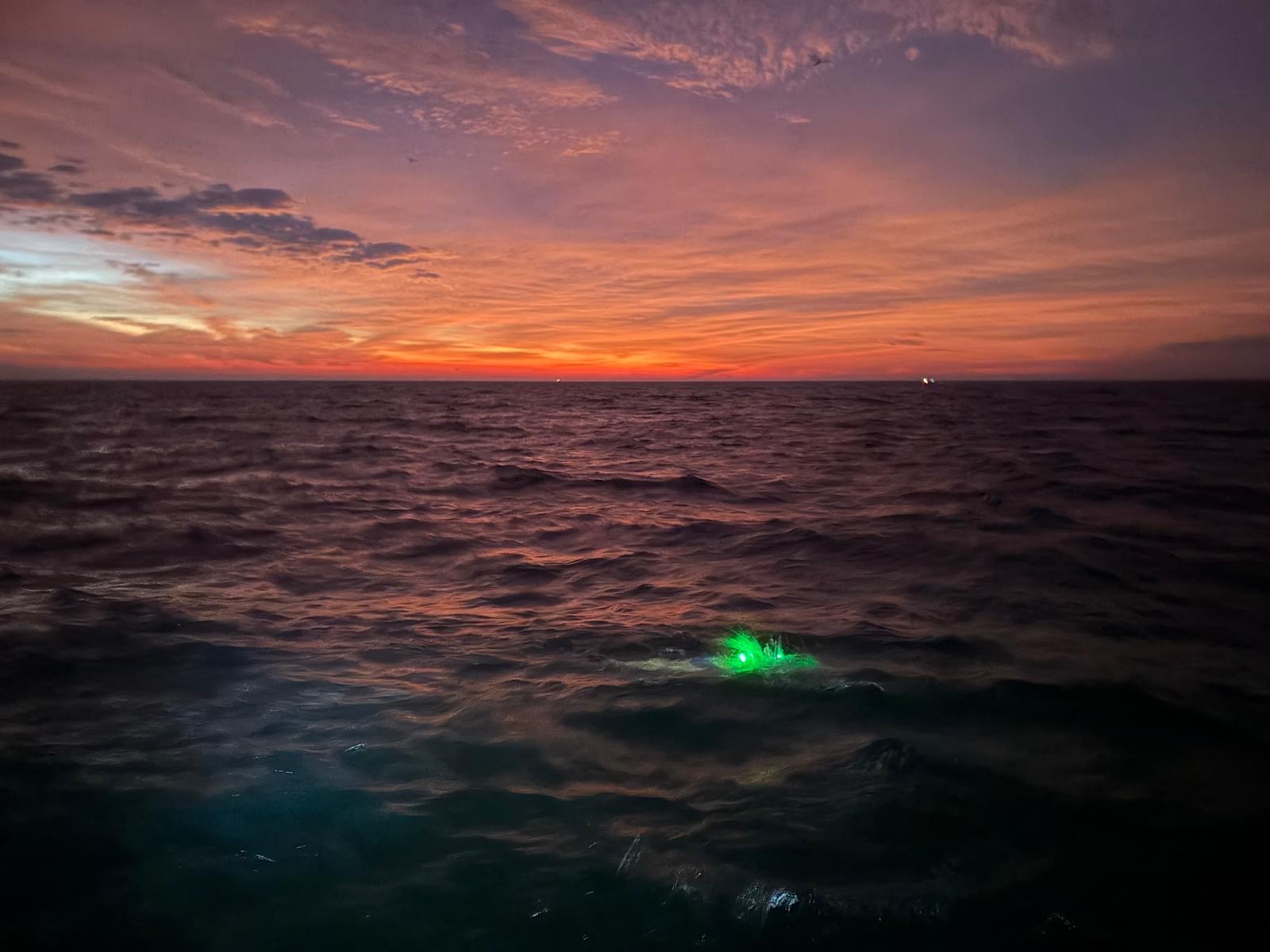
A serene ocean view at dusk, featuring a colorful sunset over the water, with gentle waves and a glowing green light visible in the foreground.

Tina got the beginning of the sunrise and I had the 10 minutes of magic I will never forget as long as I live. We carried on and the light brought the jellies to the surface. Absolute swarms of them.

On my third hour the sky grew darker and opened up and everyone onboard headed into the galley and even worse seasickness. In their rush every stitch of my dry clothing and all the towels I had bought for the team lay strewn about on the deck and were waiting for me… soaked. All understandable, it was an each woman for herself situation. Al, understanding his brief, stood valiantly at the boat deck keeping his eye on me, dripping with rain the whole time.

Tina later remarked that she was surprised to see me wearing the fancy clothes that I had brought along optimistically for an after swim pub celebration.

The tide turned. Literally and figuratively. (Tina swam 5 k in her last hour as she was swept onto the coast.) We heard a French accent on Rob’s radio, the seas calmed, we spotted France, Dionne, Tina and Janet started eating…a lot, we flew our flag, the jellies got bigger, the sun came out and Tina touched the rocks on the French shore. Crazy Canucks III came through the dark and we celebrated in the sun.
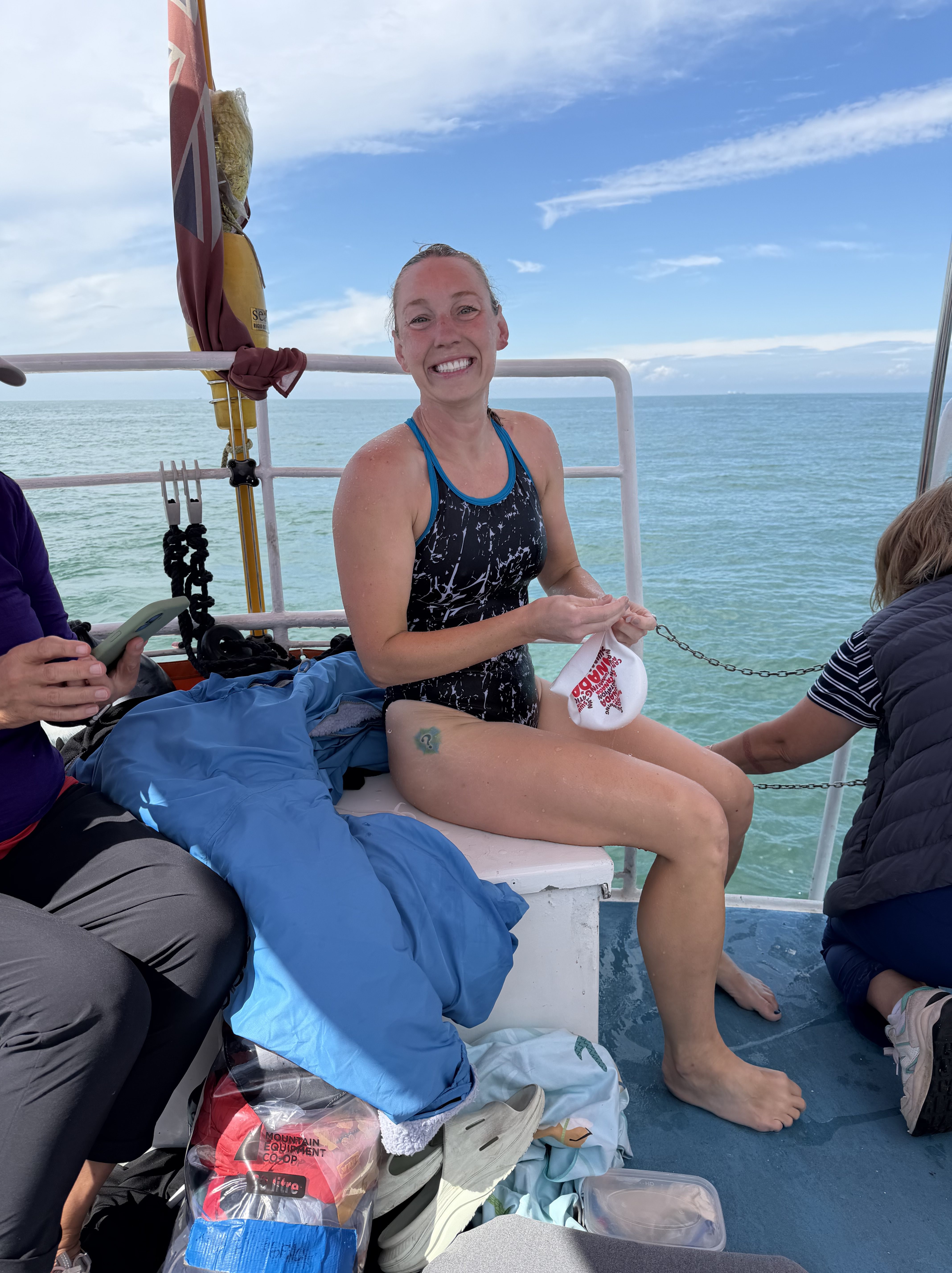
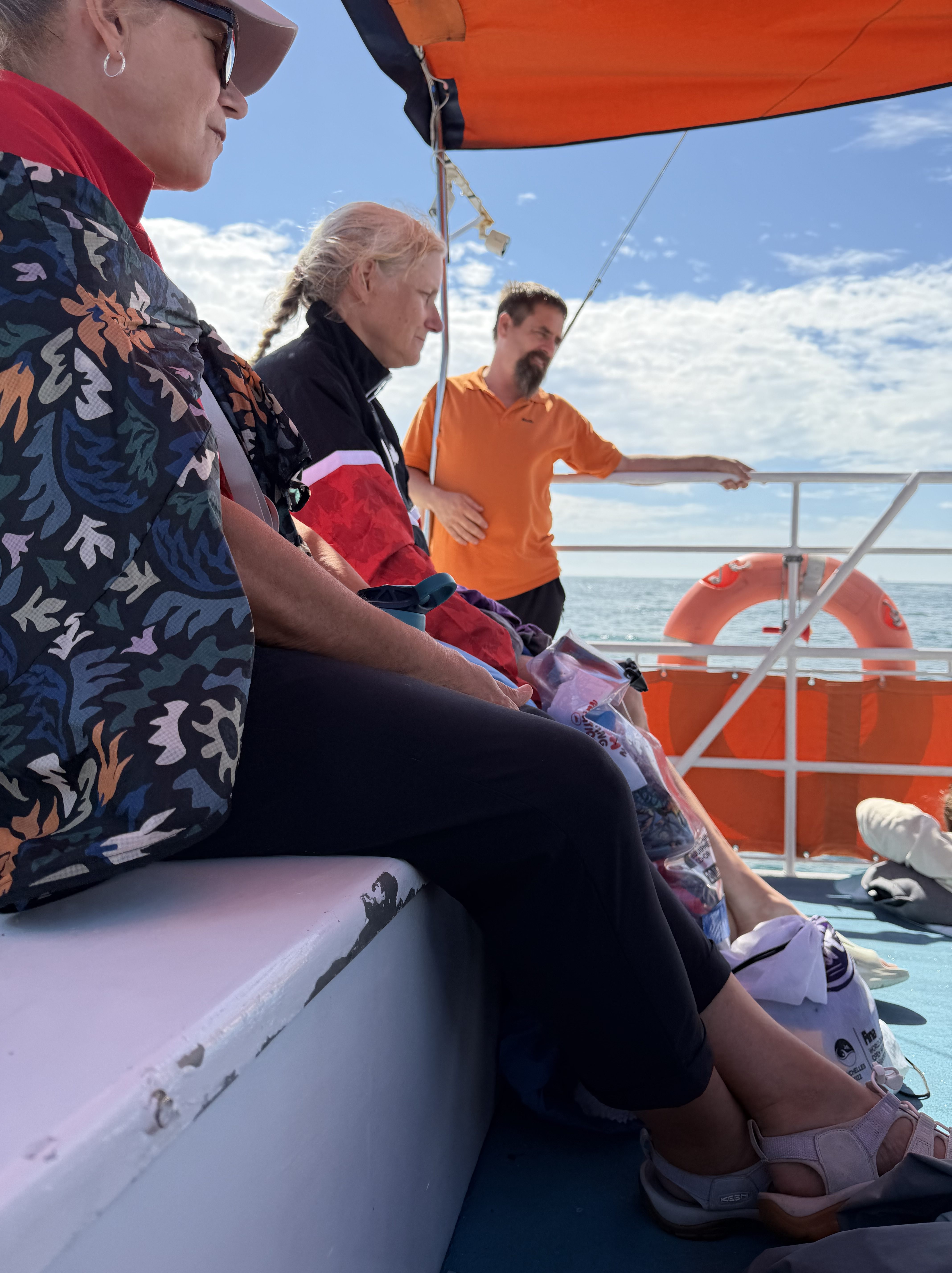
A smiling woman in swimwear sitting on a boat, holding a plastic bag, with people and bags in the background, overlooking calm waters under a blue sky.
Dionne recovers

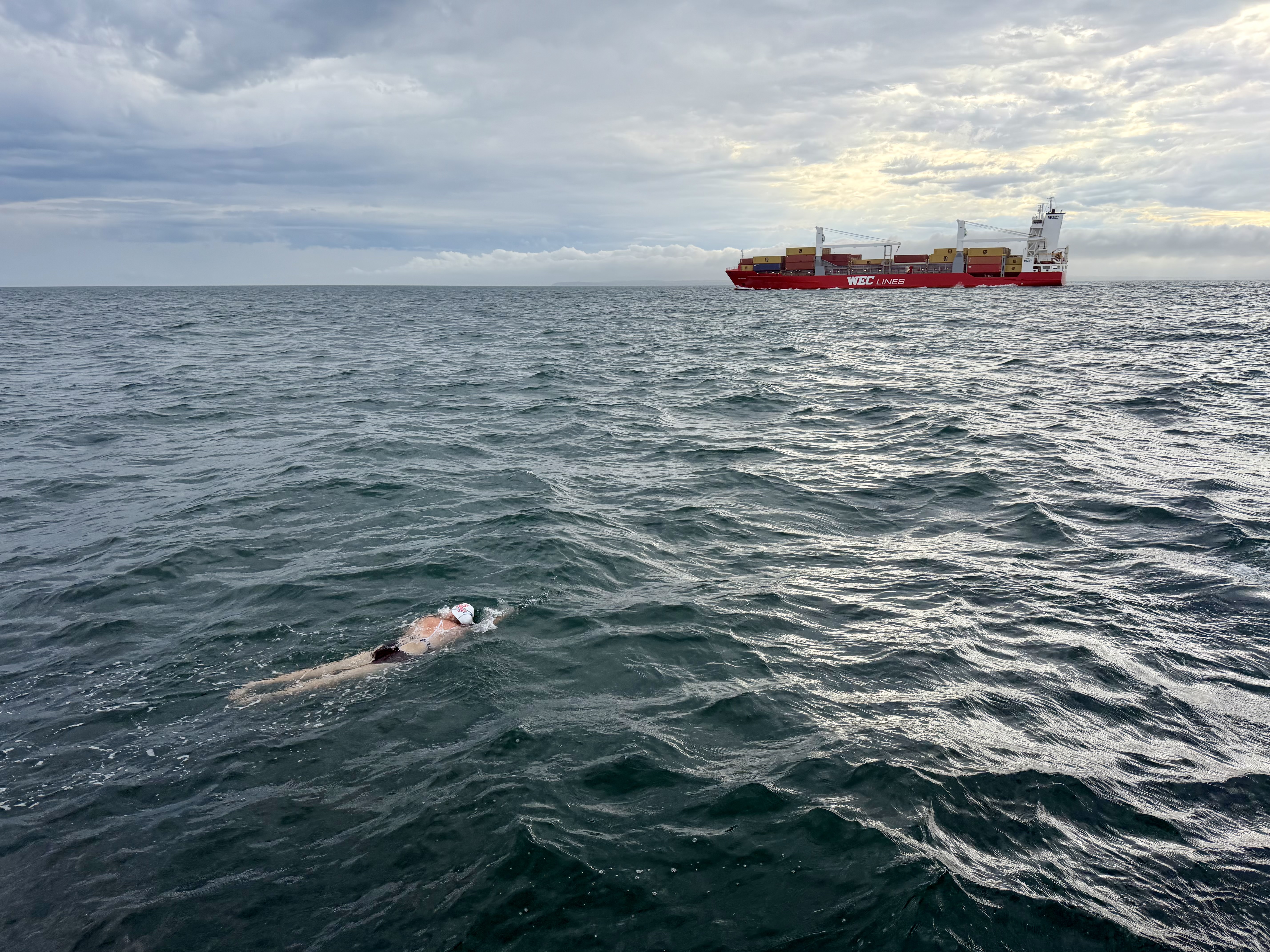
A swimmer in a cap and goggles glides through calm ocean waters, with a large container ship visible in the distance under a cloudy sky.
Tina and the Tanker in the busiest shipping lane in the world.
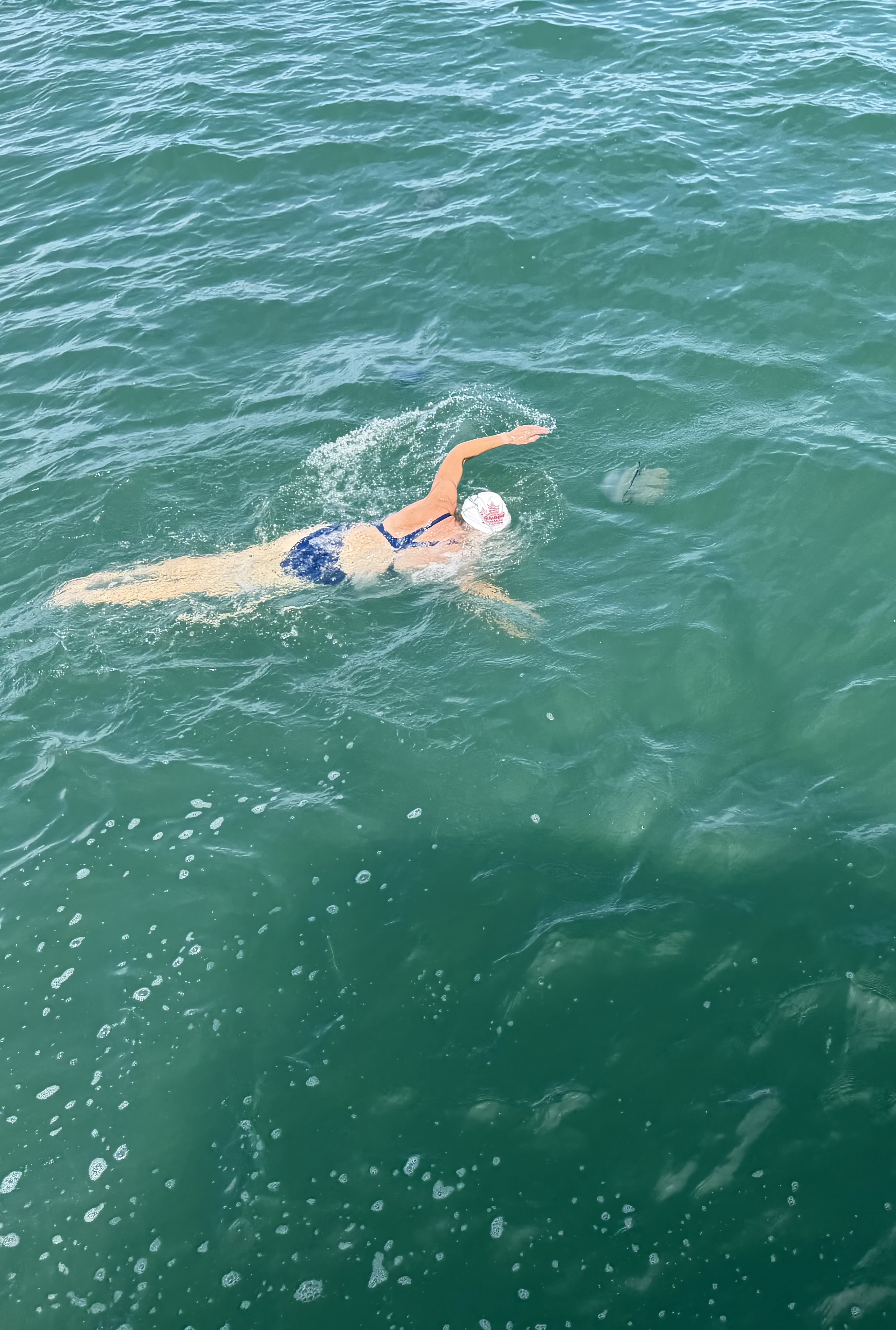
A swimmer in a blue swimsuit and white cap performing freestyle strokes in clear, turquoise water with visible bubbles and marine life below.
Tina and the barrel jelly
Map showing swimming route of 'Crazy Canucks' with a highlighted trail and time duration of 13 hours and 39 minutes.
Our swim track, pretty normal s-curve for a Channel swim with its big tides and currents.

“The event was also more rewarding than I thought,” says Tina. “Of course, getting through those hurdles made it that way, but also it is a pretty amazing piece of water, rich with SO much history. It was impossible to travel over it and not think about all the things that had happened in the English Channel.”

Couldn’t agree more. Thought of my dad, WWII pilot of Lancaster bombers as he made his perilous trips across it. So much respect too to all the soloists who tried and made this journey.

Couldn’t have picked a better 70th birthday gift. Thanks Al as always for being such an important part of these crazy adventures, Stirling too for coming on the most fantastic holiday before and after, to the team and Janet… respect, admiration and love and cheers to all those who supported us from home watching the tracker!

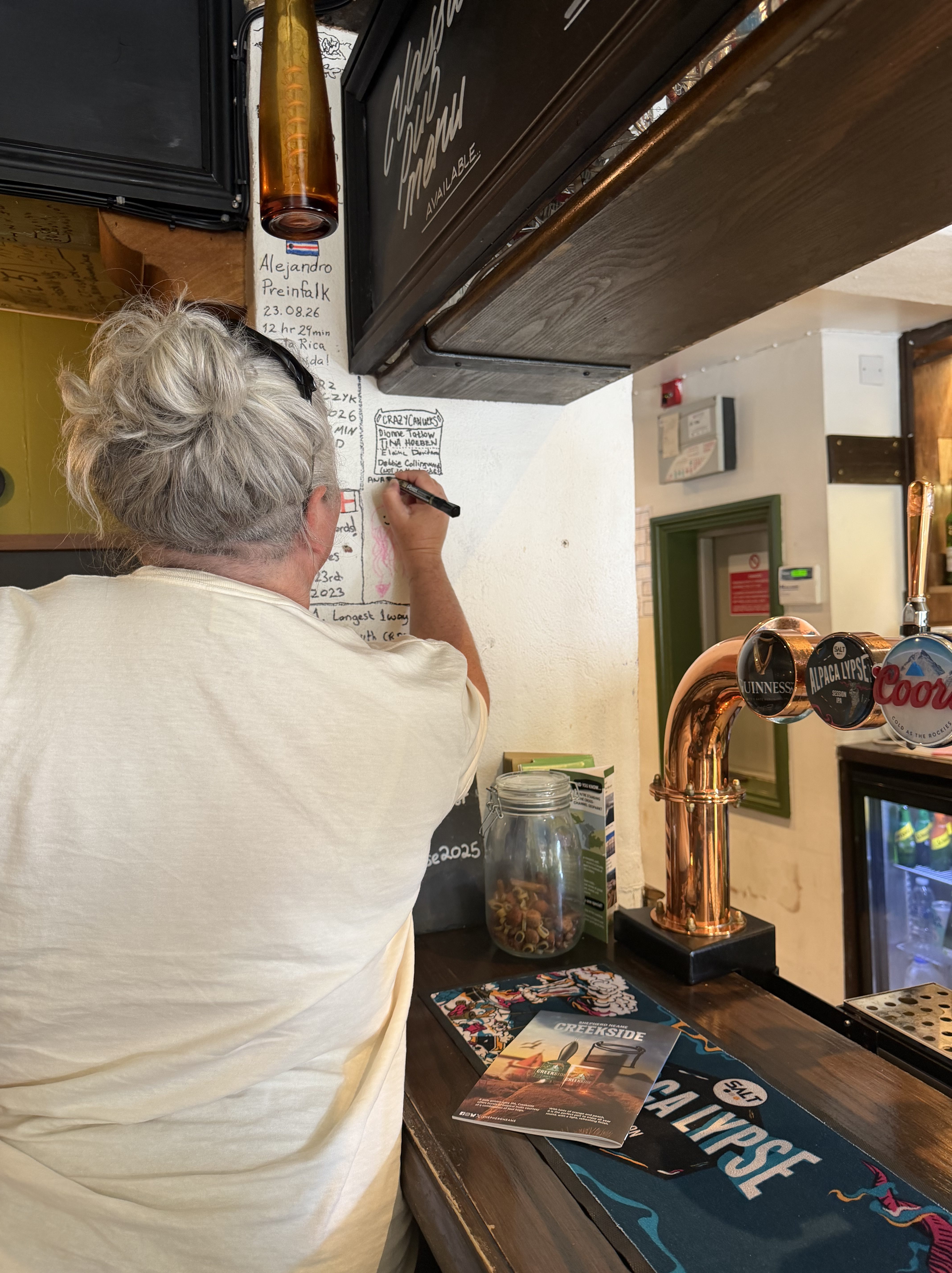
A person with light gray hair, wearing a white shirt, is writing on a wall in a pub. Behind them is a bar with beer taps and a menu displayed on the counter.
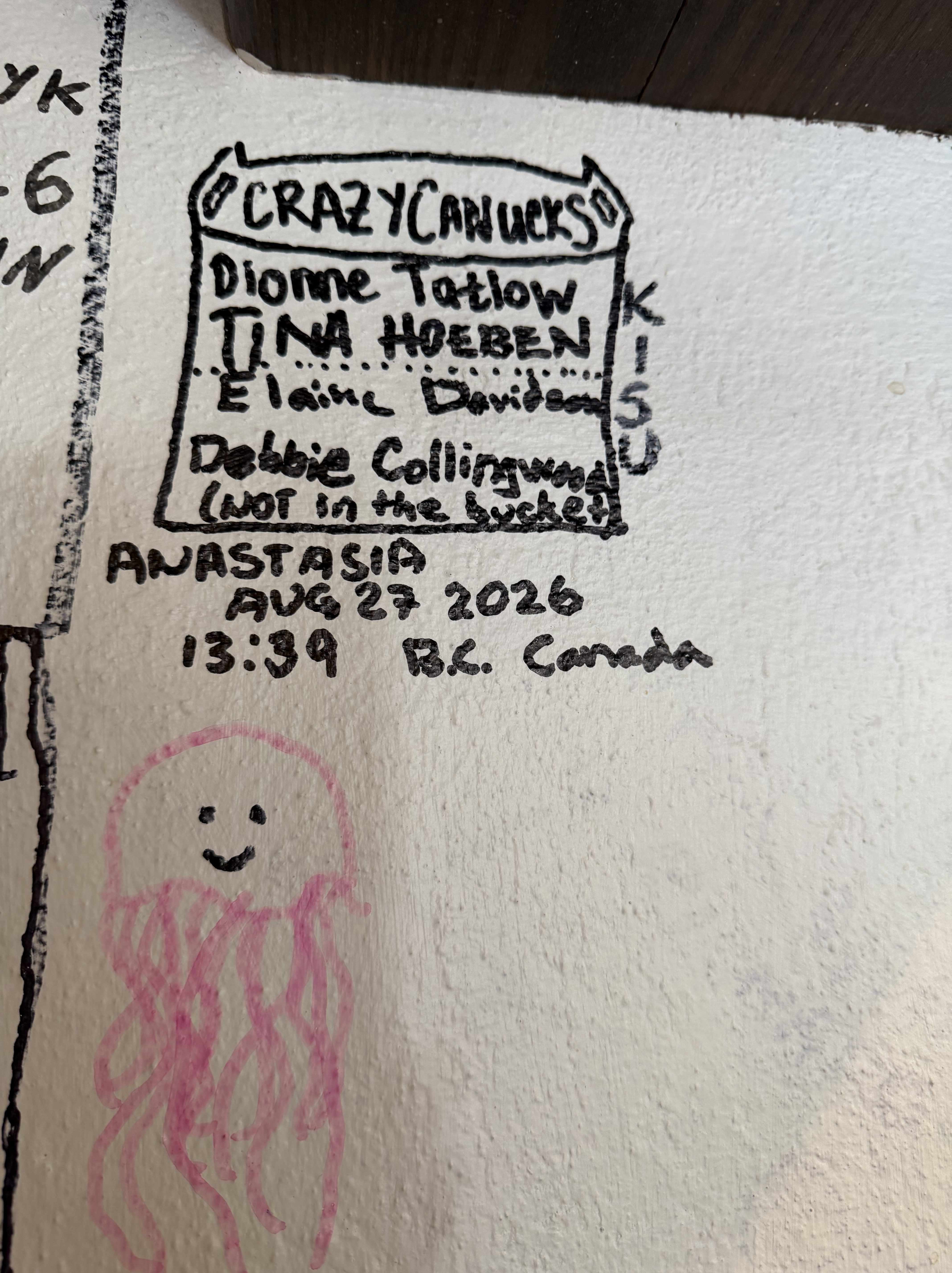
Deb, making it official by signing her name of the walls of the White Horse. She revisited her solo signature while there.
A hand-drawn note titled 'CRAZY CANUCKS' featuring names: Dionne Tatlow, Tim Hoeben, Elaine Davidson, and Debbie Collingwood (not in the bucket). Includes the date 'August 27, 2026,' time '13:39,' and location 'B.C. Canada.' A pink jellyfish drawing with a smiling face is also present.

Who knows what’s next but this August 26/27 English Channel Relay will be hard to top.
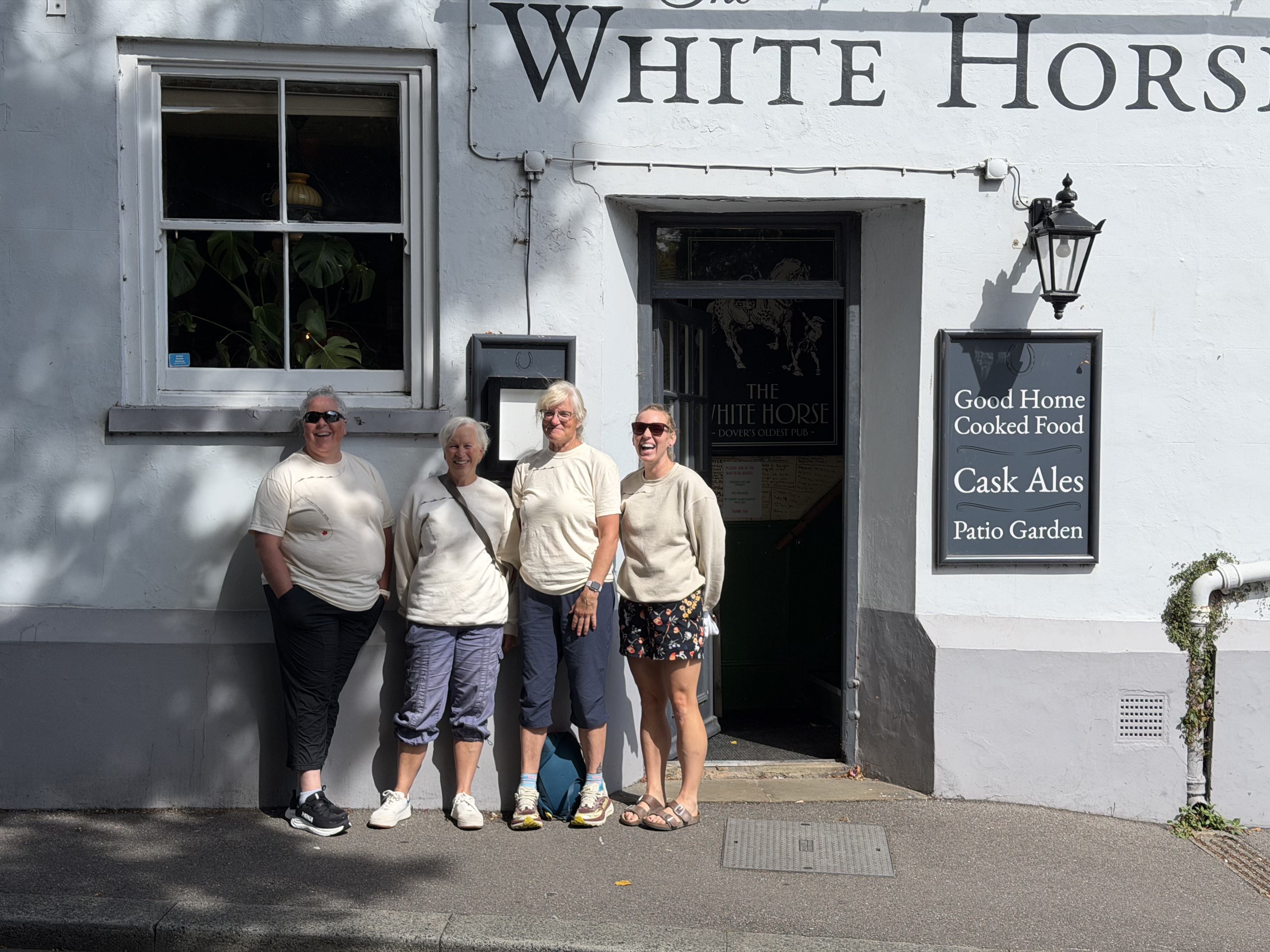
Four women standing outside a pub called 'The White Horse,' smiling and wearing matching light-colored shirts. The pub features a sign with details about food and beverages.
Deb, Elaine, Tina, Dionne

Lessons from a Failed English Channel Swim

or Nothing great is easy

Sometimes it’s so hard that it turns out not so great…

Sometimes it’s so hard that it takes two years to face writing the blog post about it all.

Sitting on the bed at the Churchill Guest House in Dover, England, in my swim robe, still shivering, tears streaming down my face, husband Al says, “It’s OK. Really. We will find you a new boat pilot, sign you up and you will try again.” This is no easy thing to propose. Three years, thousands of dollars, another trip to Europe…

Here is how it started. Looking for a really tough challenge, I convinced Jan Johnston to attempt a two-person relay of the English Channel in June of 2023. The swim came on the heels of a successful swim of the English Channel with a six-person team, the Crazy Canucks in 2016. The Crazies then took on the Catalina Channel in 2019 and finished the task becoming the first Canadian team to swim from Catalina to mainland California. A duo at 67 and Jan at 60 seemed pretty possible.

Jan in the water and me getting ready for my third shift.

Our June slot to swim the Channel was not our preferred option as its very bloody cold (14C or below) but with booking three years before a swim due to high demand and limited pilot boats, the number one slot on the tide for Viking Princess II was June or nothing until 2024.

In my research at the time Channel teams of two are pretty rare… at the time only 33 duos had made the England to France crossing and of that number only a handful had been attempted in June. I guess the thinking is you might as well do a solo if you are going to do that much swimming. The other factor, a pretty big one, is the after drop. Swimmers alternate one hour in the drink, one on the boat. An hour is not long to warm up again after 12C.

Jan and I had no illusions that we could swim the approximately 50 kilometres solo but thought with a careful training plan, dedication and lots of cold water acclimatization we could just pull it off swimming about 25 k each in alternating hours for a total of 13 to 16 hours.

We arrived in Dover feeling ready and confident. Our daughter Lizzie came for the launch of our adventure as did husband Al and Jan’s husband Jamie. Fish and chips, attempts to spot France across the Channel, draft beer and lots of laughs. Then my confidence began eroding.

Iain Hughes was 11 hours into his swim when he disappeared under the water.

While waiting for the weather to improve and the call from our boat pilot Reg that it was go time, a young, strong, firefighter died after loosing contact with his support boat. He was in his 40s. We got the go ahead for our attempt the very next day. The Titan submersible was also missing at the time and the fate of its occupants unknown. A third, much less serious mind messer was the practice swims we had been doing in Dover Harbour that seemed cool but tolerable. It wasn’t the cold it was the jellyfish that got to me. Our 2016 relay was full of the nasty buggers and I got stung on the neck but… I couldn’t see them. I had goggle issues that landed me with an old pair that I could barely see out of. Learning my lesson I had nice clear goggles on and couldn’t believe how alarmed I was by them. As Reg so colourfully said, “It’s not the big white ones you have to worry about it’s the little purple f****ers that sting like hell.”

Jan and I boarding the Viking Princess II at 3 a.m.

We got the call from Reg and it went something like this. “Hey Reg, I’m a bit nervous after the fellow drowning yesterday.” Reg replied, “This is a dangerous sport and it has big risks.”

Five minutes later Reg called back and I could hear his wife in the background. It was clear she had convinced him to call us back. “You will be alright love. We have cameras on the boat on the swimmers at all times. We will keep a good watch.”

Jan and I and our partners sat in the lounge and discussed my mental wobbles before we had to gather our gear and head out into the middle of the night to the boat. “I do this for fun and right now this doesn’t seem too fun,” I said. “I don’t want to end up in the hospital or dead.” Sounds a bit overdramatic but it was the head space I was in… Jan and Jamie said they would respect my wishes but said we had trained hard, we were prepared, we had spent years and lots of money and they were game to give it a go. So go we went.

Jan in Channel in our first hour.

We had our first successful crossing with Reg and his brother Ray, famous Channel boat pilots so felt confident in their care but they seemed gruffer, less patient and less encouraging than they had a decade earlier. There was no warming up in the boats inner cabin during our hour shifts out of the water, a lot of talk about how fast we could do the crossing as it felt like they didn’t want to be out for hours and hours and hours and what felt like terse explanations of how the shift changes would be handled. I was mildly disappointed they didn’t remember us from our 2016 swim as they hadn’t piloted Canadians before and we took them for a big pub after party.

Brave Jan took the first shift from rocky Shakespeare Beach in the pitch black and stroked steadily for her hour. After a fumbling shift change (the boat is equipped with an elevator type device to re-board) I plunged in and felt calmer as my hour progressed. The jellies were EVERYWHERE but in the general crazy stress of the whole experience they became just a factor that could be largely ignored. The water felt cold but nothing I couldn’t handle.

Me on my first shift. The green light on my back is to make me more visible.

Back out on the boat I was cold. I changed into a dry suit, bundled up and sat in a miserable stiff shivering block. The thermos of warm electrolytes tasty absolutely horrid. We hadn’t thought to wash the borrowed thermoses out so mistake number one.

I assumed Jan was struggling with the cold equally as we had no communication with each other. My second turn I got down to business and took advantage of the calm seas to make some tracks. Reg began to look more hopeful that we would make the crossing in a reasonable time.

Seas this calm are a Channel swimmer’s dream.

My second shift in the calm seas with the sun breaking through was good until about the halfway mark where the cold (12C) started to break into my focus. By the last 15 minutes I was actually shivering. To combat it I picked up the pace. Normally in these swims at the point you start looking forward to a warm drink, your swim robe and getting more comfortable once your hour is up. I had a sinking feeling that the after drop would be bad. It’s the phenomenon when your core body temperature continues to drop after you’ve exited cold water. The cold blood in your limbs returns to your core and it’s nasty.

The hour break was miserable, even more than I anticipated. When you get that cold you don’t feel like moving which you definitely should. I only managed a few sips of the thermos, clung to the hot water bottle and shivered uncontrollably.

Al is my rock.

At this point its becoming obvious that Jan is handling the cold better than me. I spotted her getting ready for her shift while I was in the water. She had her robe off and was bouncing around. I was still cold and shivering after my hour breaks. In my fog this difference didn’t register.

In I went for my third hour. At this point we are approaching the halfway point in the Channel and our pace was holding. After only a short while I began to shiver. This was new to me. Shivering while swimming is your body’s natural reaction to cold as it tries to generate heat through muscle contractions. In open water it signals potential hypothermia.

I didn’t know that it was a serious sign but I did know I had never shivered while swimming.

I started counting strokes knowing roughly 100 strokes is 100 metres so another two minutes gone. Counting strokes is a sign of a big effort for me and as a way of distracting myself from the time passing. Again, the thought of the hour on the boat provided no comfort but a worsening dread.

I knew I was at my limit. I made it through the hour somehow and got back on the boat. The poor guy who disappeared the day before likely succumbed from hypothermia. I thought about Al and my kids. I decided to tell Al and Jamie I was done. Al knows me. He knows I’m tough. He knew it was time. Jamie suggested I give it awhile to see if I can come around. “Jan is fine in there.” I assumed she was feeling exactly as I was and wasn’t fine at all.

This is all I can bring myself to write about this. For two years I’ve wondered what I could have done differently. More cold water training, forcing myself to move around more on the boat and on and on. I’m sorry I let Jan down. I’m so thankful for next year’s Crazy Canucks five-person relay and with time I’ve given myself some grace. “Nothing great is easy,” said Captain Webb, the first to swim the Channel. It’s always a balancing act between ability, will and a big challenge and this time I came up short or with grace this time I made the right call to quit before I got in real trouble. The next victory will be even sweeter.

Jan was gracious about my call to quit the swim. For her, it was a victory as she is one of the few to experience what it’s like to attempt a Channel swim. She couldn’t be persuaded to give it another go with all the sacrifices she made.

Crazy Canucks III made up of me, Dionne, Deb, Kate and Tina and we have a swim window of August 27 to September 3 2026 on the Anastasia with boat pilot Eddie Spelling. (Eddie piloted the swim where the poor firefighter succumbed but he also took Sarah Thomas on the four-way that no-one thought could ever been done.) Deb has swum the triple crown which includes a solo of the English Channel, Catalina and Around Manhattan and is going for the fun of the team aspect, some nostalgia perhaps and seeing part of the swim from the boat, Dionne is tempted to try a solo and is going to see what’s involved, Kate, also an experienced open water swimmer has swum it in a relay 19 years ago, Tina is an all around adventurer with many athletic achievements on her resume looking for some new “fun”. I’m going because Al said I could.

I’m happy we are going in August when the Channel is at it’s “warmest”, a relatively balmy 16-18C. I’m happy for more team buddies so more time to get warm. It’s not a gimme by any means as we need the right conditions for the swim during our swim window. Sometimes the weather gods are not in your favour and you don’t even get an attempt. Seasickness is also a bit of a factor as are those damn purple jellies. With a bit of luck I may get my 70th birthday present and it will be great. I’m grateful for Al, my kids and the amazing group of women who have signed up for the adventure.

Our summer with the bees

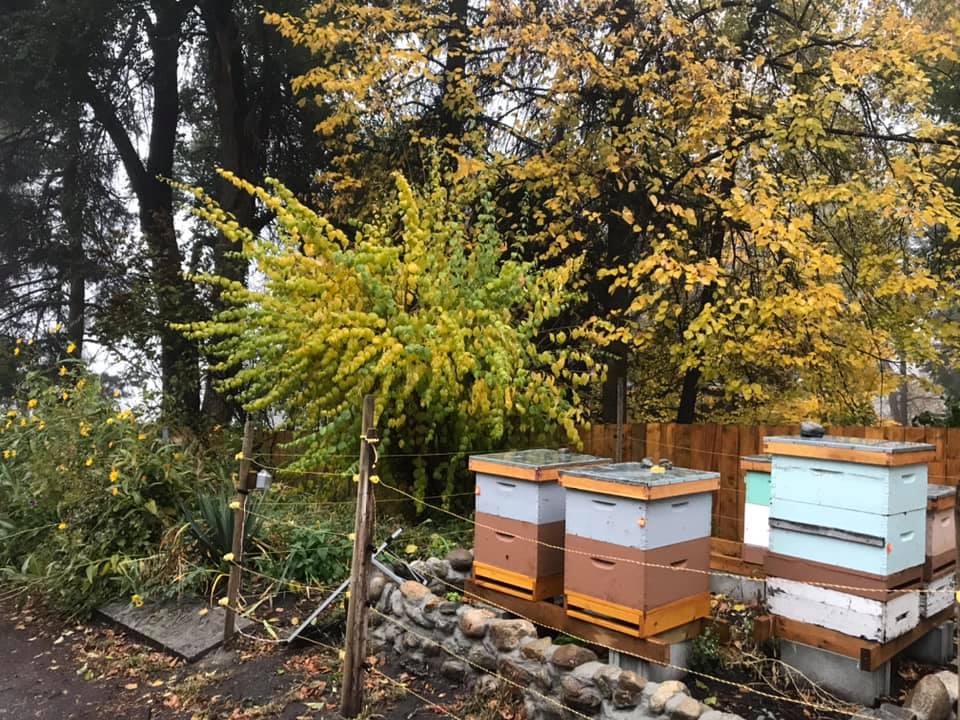
They emerged from the hives and swarmed up and sideways in a buzzing disorganized chaos that had me re-thinking the wisdom of this whole idea. What will the neighbours think? Will they sting us? There are too many of them. This is kind of frightening. Might have to call Tim back and say we have changed our minds.

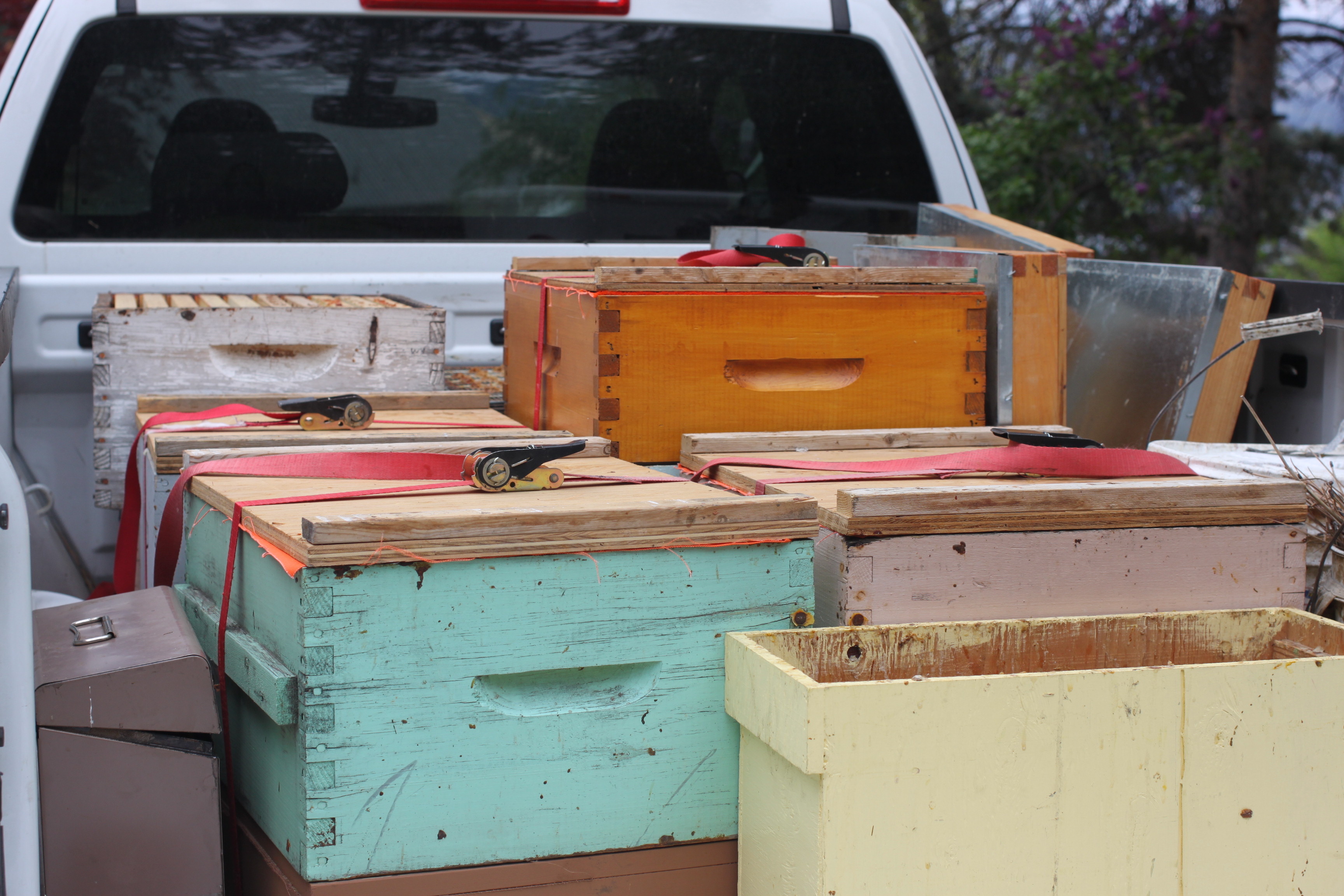
A corner of our little farm became a bee yard in May of this year after winter discussions with local beekeeper and bee inspector Tim Bouwmeester of Desert Flower Honey. He rents bees out to local orchardists and has several more permanent bee yards in the area. After looking at our raspberry farm he agreed to place some hives here year-round after erecting an electric fence to discourage roaming bears.

We were pretty excited on the day the bees arrived.

Tim warned us that the bees would be disorganized for a few days until they settled in and oriented themselves to their new territory. After a few days of giving them a wide berth my anxiety waned and the love affair began.

Checking on the bees

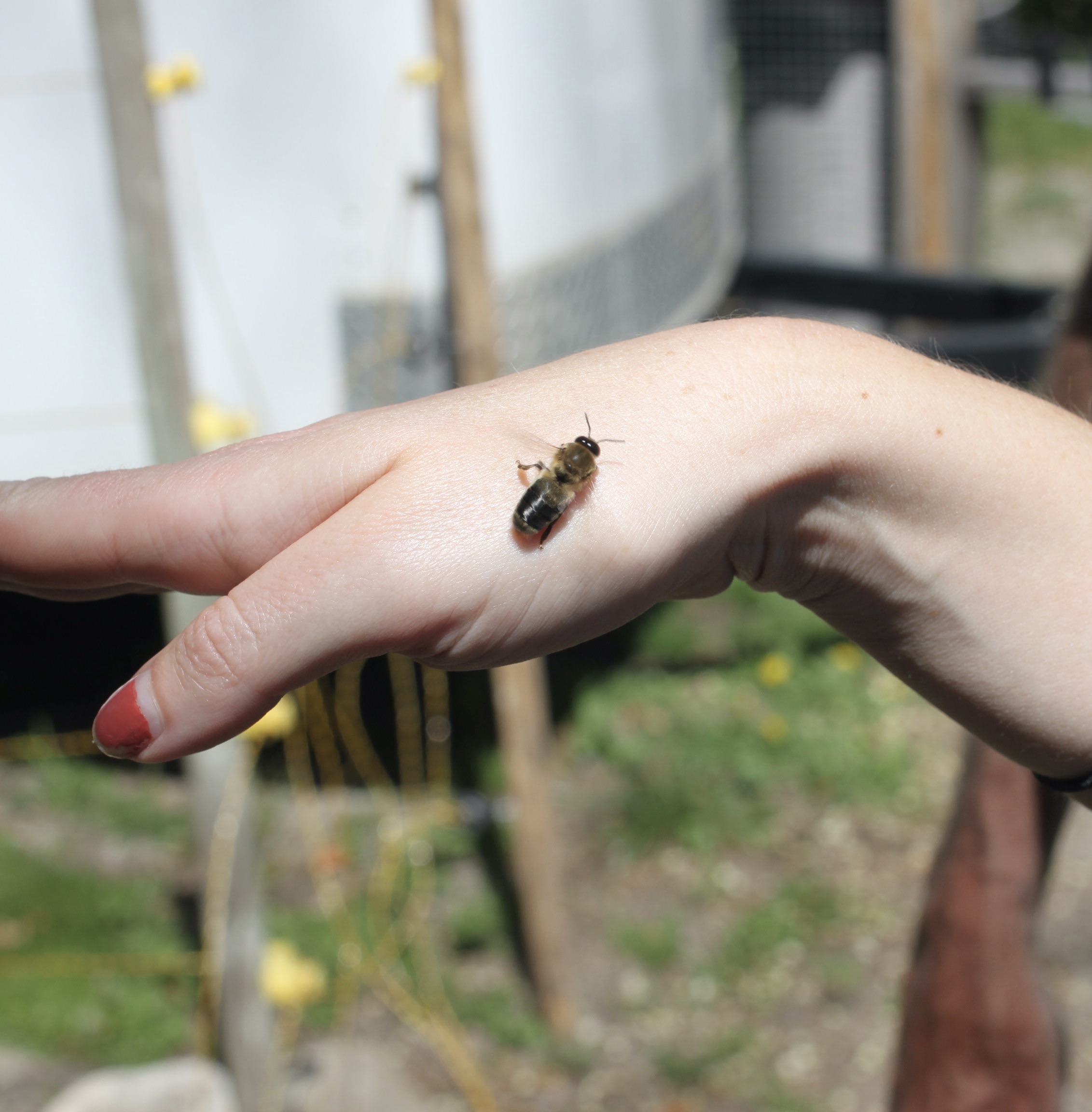
We watched as the bees developed their routes to find nectar and pollen and their flights into and out of the hives became much more organized. Tim would come by every two weeks and calmly work with the bees while we watched and peppered him with questions. Wearing only the beekeepers hat and veil and tucking his socks into his pants he checked on the status of the queen, checked and treated the bees for mites and generally determined the health and strength of the hives. We helped in minor ways and I took photos.

Part of Tim’s bee passion is breeding queen bees and he selects for what I call niceness. His bees are as non-aggressive as they come. “As an inspector I see lots and lots of hives and many bees fly up all around you and get much more agitated,” Tim says. Who knew that we have exactly the right bees for rookie bee hosts?

We had a bee sting free summer and supportive neighbours interested in the project. Tim did get the odd sting working with the hives by inadvertently squishing a bee here and there that let him know but he says he used to that and after a brief hand wave the sting is forgotten.

Fascinated by what Tim tells us and shows us about the bees, we are happy to have them on our little farm but also not tempted to get our own hives and learn to be beekeepers. There is so much to it and the science to good beekeeping is evolving all the time in the face of climate change, diseases and pests like mites. “It is not a hobby to be taken lightly,” says Tim. “You really need to get educated.”

As for what we can do for the bees and other insects in our yard and in the Okanagan where we live, Tim says the biggest problem they are facing is lack of good forage. Our wine growing region is not great for the bees as grapes are wind pollinated. By cutting down orchards to grow vines we are creating a bee desert.

“We are too good at controlling weeds as well,” he says. “I am encouraged by new organic vineyard practices though. Cover crops of clover in between the vines is great as is using less herbicides.”

As for what all of us can do with any plot of land, Tim says don’t cut the grass as much. Let the weeds go. “Plant a meadow like you did or let even a part of your yard go a bit wild.”

Tim does regular tests and treatments for mites.

In addition to our raspberries, blueberries, haskups and blackberries (which bees love) we planted our meadow this summer and it was alive with bees and hummingbirds.

I now have another excuse as a gardener to plant more flowers.

We love showing visitors around our farm and the bees have become a part of the fun.

Visitors have often been lucky enough to be here when Tim comes to check on the bees.

I like the look of the hives…

Even with the hottest summer on record in the Okanagan, the bees did their thing. “It was a crazy summer,” said Tim. “I was surprised by how well the bees did. I still don’t know where they got their nectar from.”

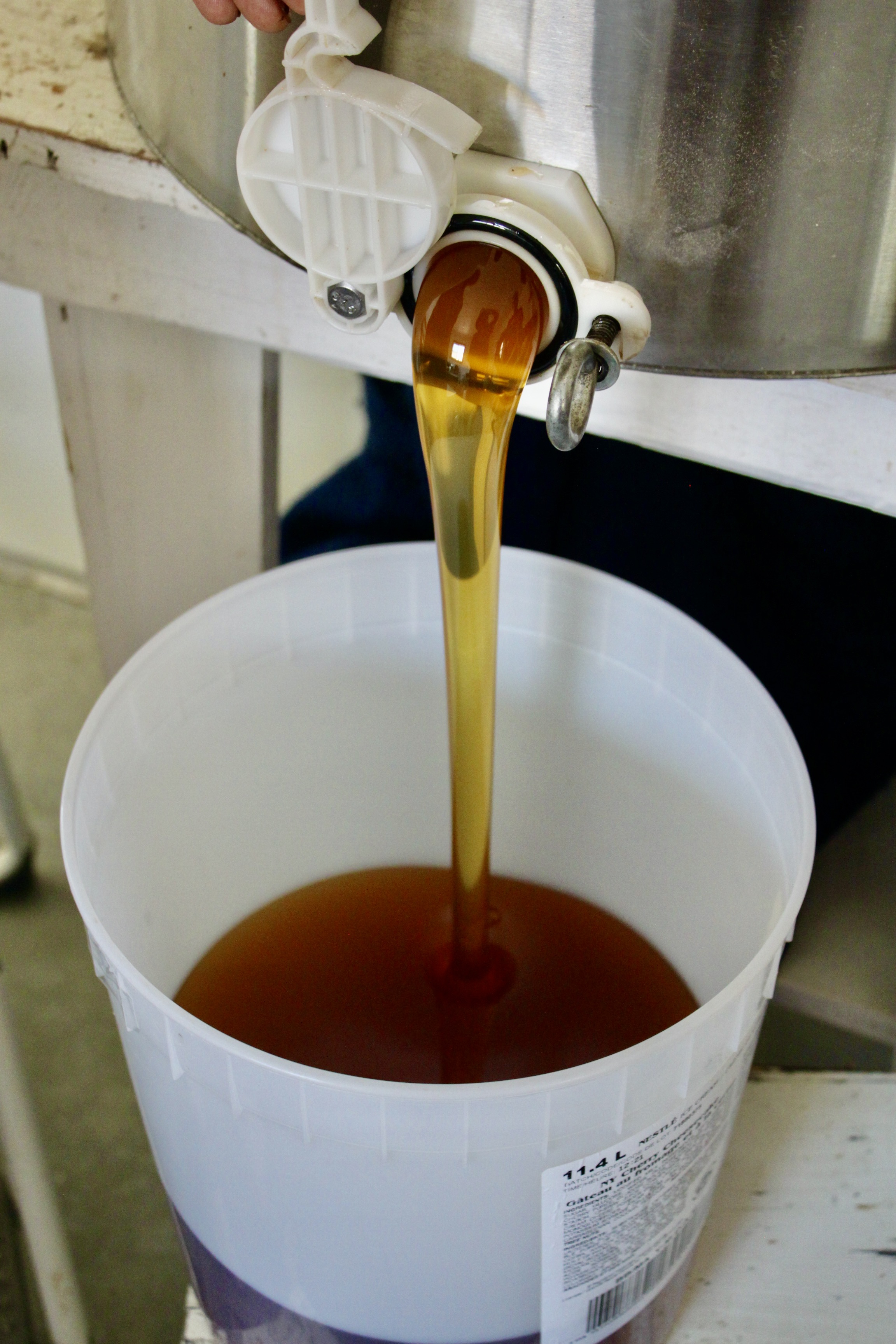
Tim takes the supers filled with honey to his honey house on Naramata Road (near Hillside Winery) at the end of the summer.
Fancy machine that extracts the honey.
End product after filtration.

As a bee host Tim ended the summer by dropping off a 3 kilogram pail of honey for us and it’s the best honey I’ve ever tasted.

We have a lovely winter’s worth of honey for us and some to give to friends and family.

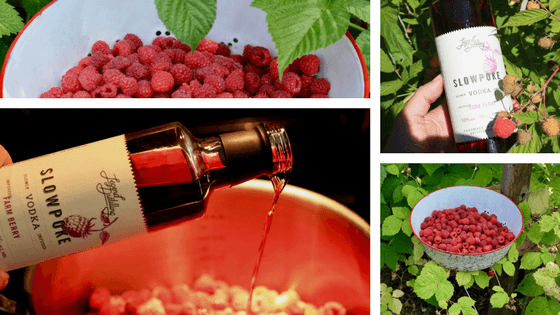
Naramata’s Legend distills our hottest summer on record into a liqueur

Bring on the heat

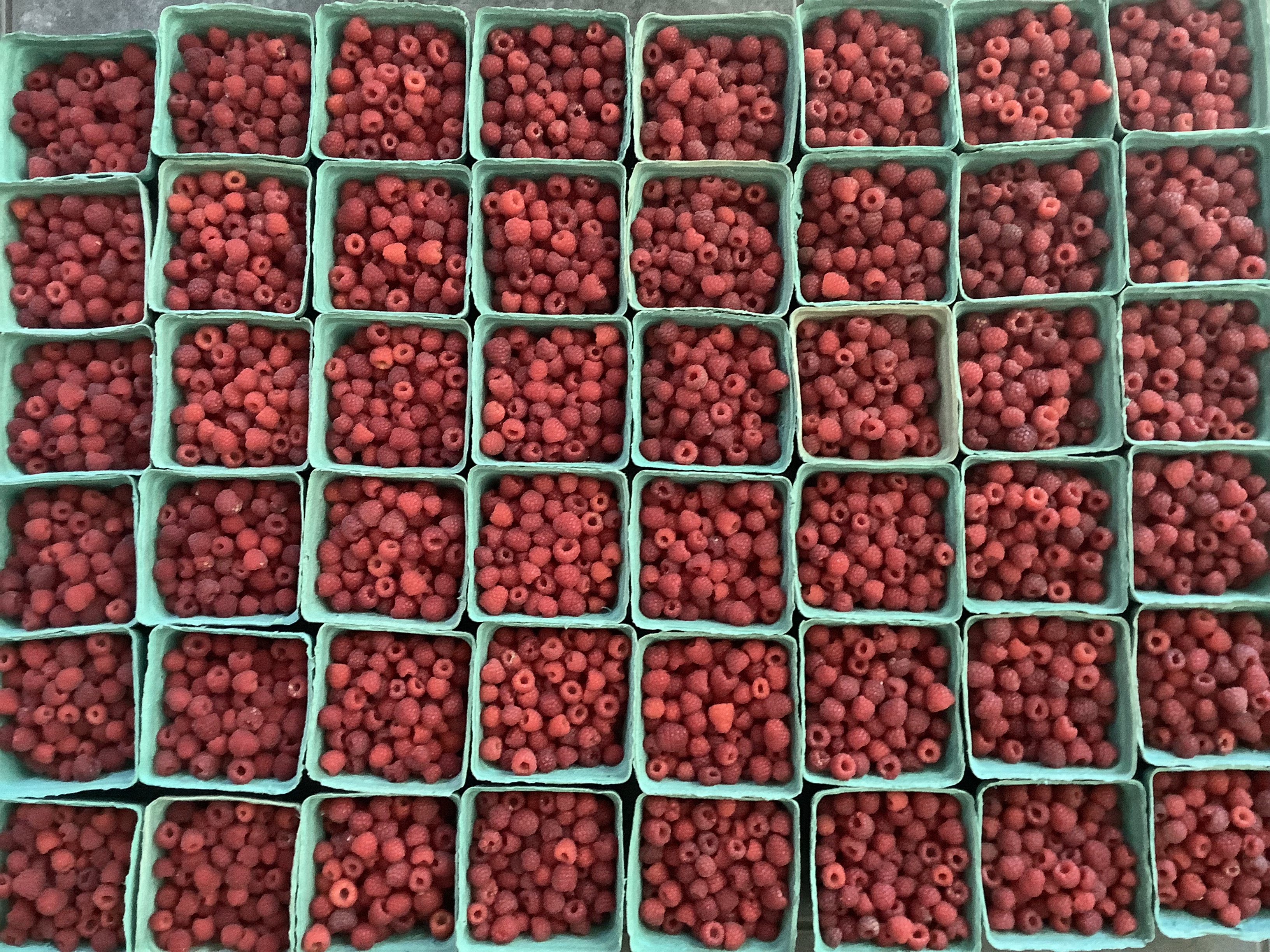
Our Carpe Diem Farm raspberries fought hard through a heat dome that saw temperatures soar to 45 degrees C as did the jalapeño peppers grown in Naramata at https://www.puzzlegrassfarm.com and https://www.plottwistfarms.com. Our careful watering and tending combined with Legend Distilling’s artful magic has resulted in a spicy warming liqueur. It’s sort of an “out of the frying pan and into the fire” situation for our raspberries and the Naramarta peppers and the result may well become legendary.

We lost about a third of our crop this year due to extreme heat so these sweet survivors deserve their special Legend Distilling boozy end.
“Legend has it…(well actually…science states) that jalapeño peppers contain capsaicin – which when consumed – can make some people feel a sense of euphoria, similar to a ‘runner’s high’.

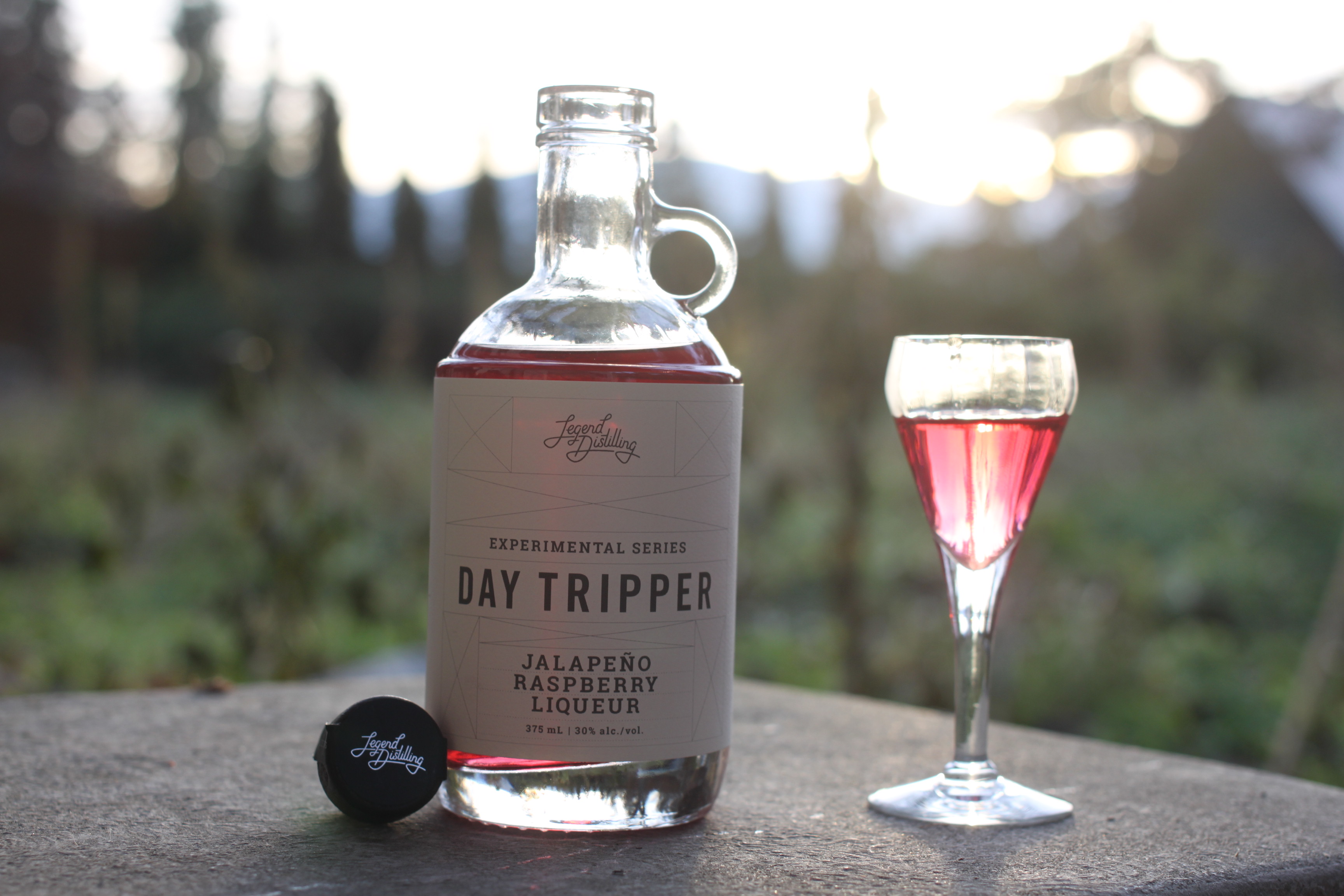
This 30% alcohol by volume Jalapeño Raspberry Liqueur is the first release in Legenddistilling.com new experimental Day Tripper series. “It allows us to showcase the bounty of our local area in very small batches,” says Legend’s Dawn Lennie. “Each flavour is unique and available just once, or maybe once again. You just never know.”

As the label says, “Life is one big experiment – choose your drinks wisely.” Legend’s distillery location is abundant with fresh ingredients. Our raspberry farm is literally just down the street from Legend and the two farms that provided the peppers just minutes away.

The colour is lovely don’t you think?

The liqueur has a distillate base of Legend handmade vodka made from 100% British Columbia grown wheat and the fruit infusion is our raspberries and the peppers.

The liqueur pairs well with tequila to make a spicy margarita, vodka (think jello shots or a gimlet) Legend’s Black Moon (smoke and spice) or Legend’s Naramaro or other Amaro Liqueurs.

Dawn says it works a great replacer for Fireball if you need a warm sip after a day of skiing, snowboarding or sledding.

Mixers suggestions for fun and easy sippers or if you want to dream up a festive cocktail include mango, cranberry and apple juices, ginger ale, fruit punch, orange, pineapple, raspberry juices or fresh lime or lemon juice.

Try it in shooters for a kick, says Dawn. It also pairs well with melon and banana liqueur, peach schnapps, raspberry sourpuss, framboise, and orange liqueur or coconut rum.

Ready for a first sip.

In 2013, Doug and Dawn Lennie took over the site of the former Naramata doctor’s office and transformed the property into a distillery and tasting room, complete with patio, garden and outdoor restaurant with one of the best lake views in all of Naramata.

Passionate about local ingredients, the Lennies support local farmers, producers and small businesses in the community. “We are able to tell a story through the spirits and provisions we make; a story of this amazing place, it’s history, it’s legends and the incredible people who live here,” says Dawn.

The making of a meadow

It took only 10 weeks from planting to transform a bare patch of poor soil to a magical meadow alive with bees and birds in a Naramata, British Columbia, Canada garden.

From sceptic to meadow evangelist and more literally from septic to sun kissed field of beauty our making of a meadow project has been one of the most satisfying garden projects we have ever undertaken.

Our 2,500 square-foot traditional lawn that was watered, fertilized, aerated, and mown and mown and mown was the victim of a total failure of our old septic system. According to https://www.chapters.indigo.ca/en-ca/books/lawns-into-meadows-growing-a/9780998862378-item.html Owen Wormser, lawn mowing itself is a major source of pollution. Greenhouse gas emissions from mowing, along with fertilizer and pesticide production, watering, leaf blowing and other lawn management practices, were found by a University of California-Irvine study to be four times greater than the amount of carbon stored by grass. Lawns are an expensive, time-consuming ecological catastrophe.

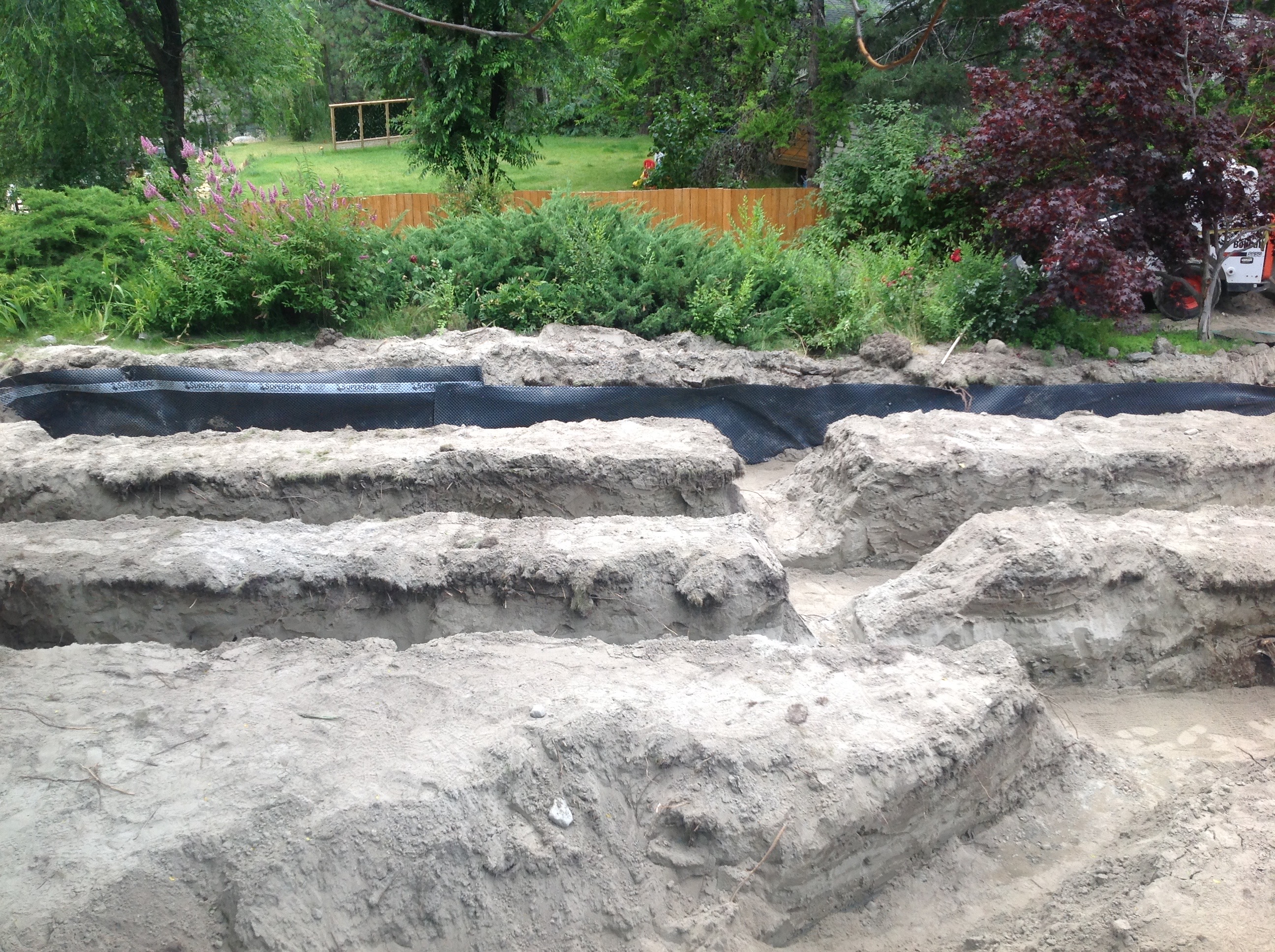
Work being done to instal our new septic system and field gave us the opportunity to try something new rather than re-plant our lawn. That’s why I call this project from shit to shinola.

Step one

Plant a cover crop of rye grass to keep down the weeds and to fix nitrogen into our poor sandy soil.

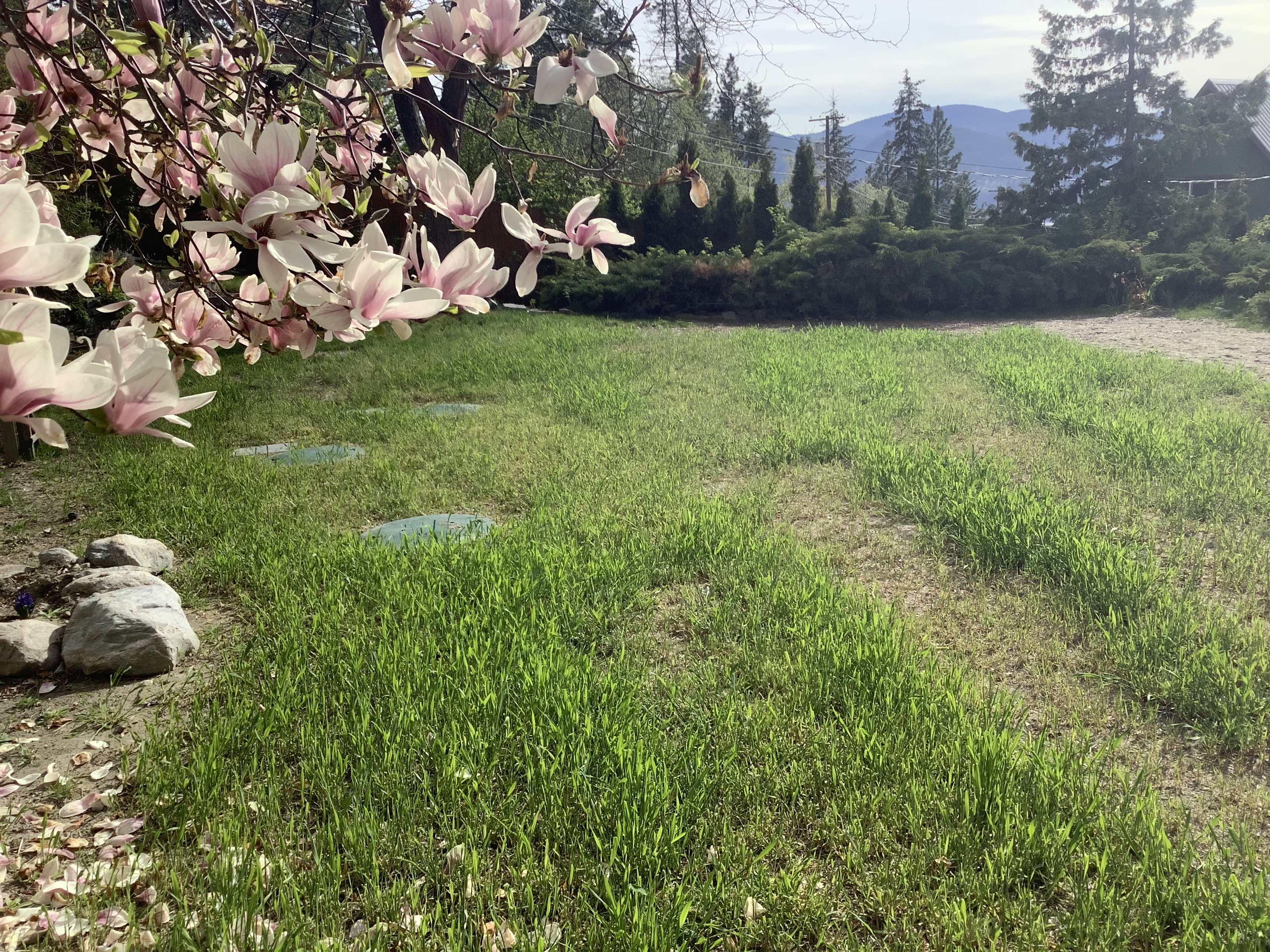
We planted a cover crop of annual rye grass in the fall and kept it mowed to prevent it from going to seed.

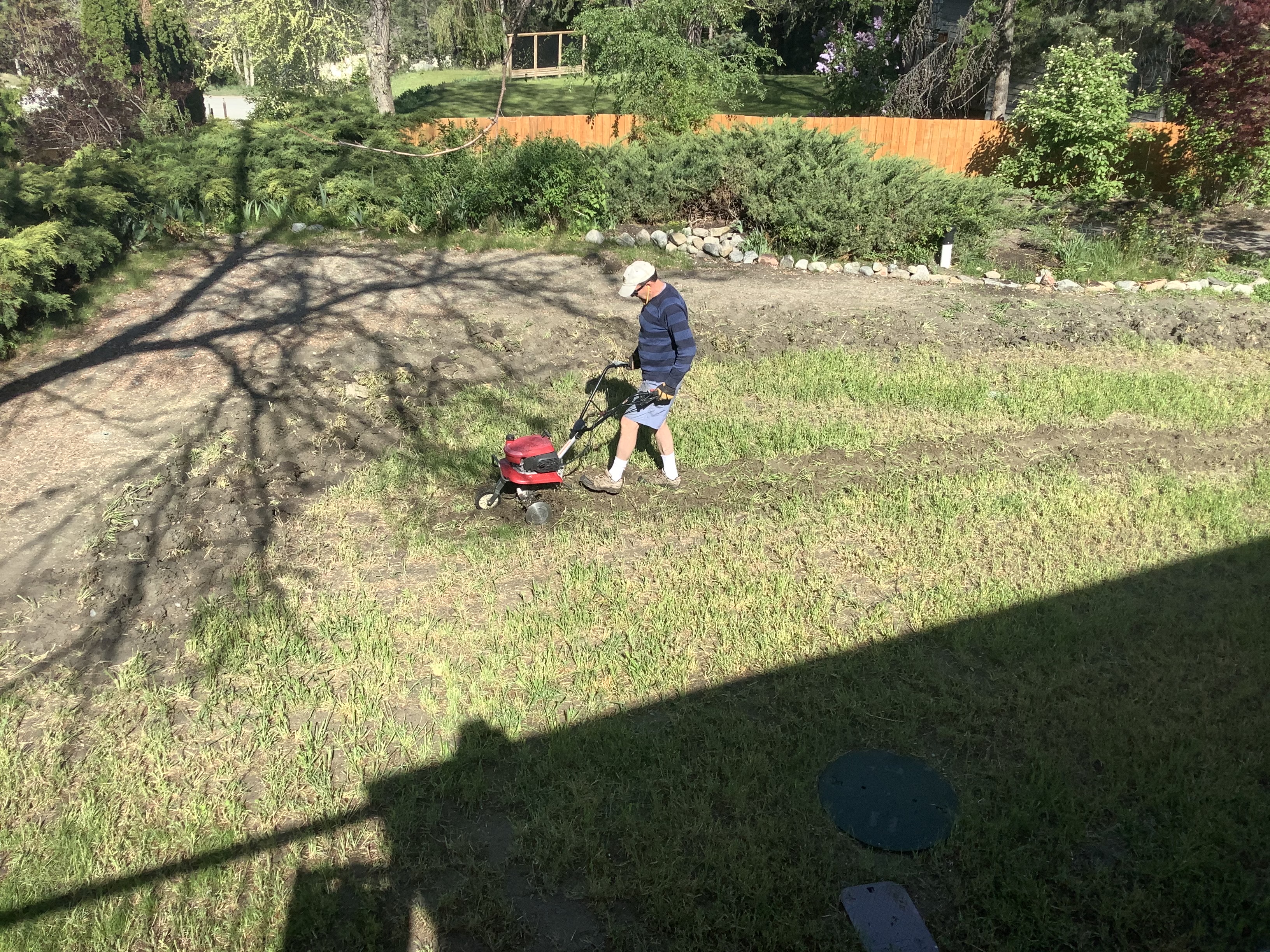
Step 2

Till in the rye grass in early spring.

If you aren’t starting with bare ground you need to carefully remove all of your lawn grass as it will compete with your wildflower seedlings. This could mean lots of back-breaking shovelling or rent a turf cutter.

Step 3

Rough up the soil with a rake

Step 4

Seed

We chose a number of wildflower seed blends from westcoastseeds.com

Here are the seed blends we chose for our project:

Pacific Northwest Wildflower Blend that includes Baby Blue-Eyes, Bird’s Eyes Gilia, California Poppy, Blue Flax, Blanket Flower…

Southern Prairies Wildflower Blend with Dotted Gayfeather, Greenthread, Hoary Vervain, Five-spot, Tidy-tips…

Hummingbird Wildflower Blend with Four O’Clocks, Lemon Bergamot, Scarlet Sage, Phlox, Wild Petunia…

Knee High Meadow Blend with Baby’s Breath, Black Eyed Susan, African Daisy….

Biodiversity Blend which includes basil, Bishops Flower, Lupin, Borage, Chinese Aster, Ox-Eye Daisy, Yellow Mustard…

And for good measure and because we like her… The Dr. Bonnie Henry Pollinator Blend which is a mix of Cosmos.

With regular irrigation to get the seeds going, here are the results of the first 10 weeks of our glorious meadow.

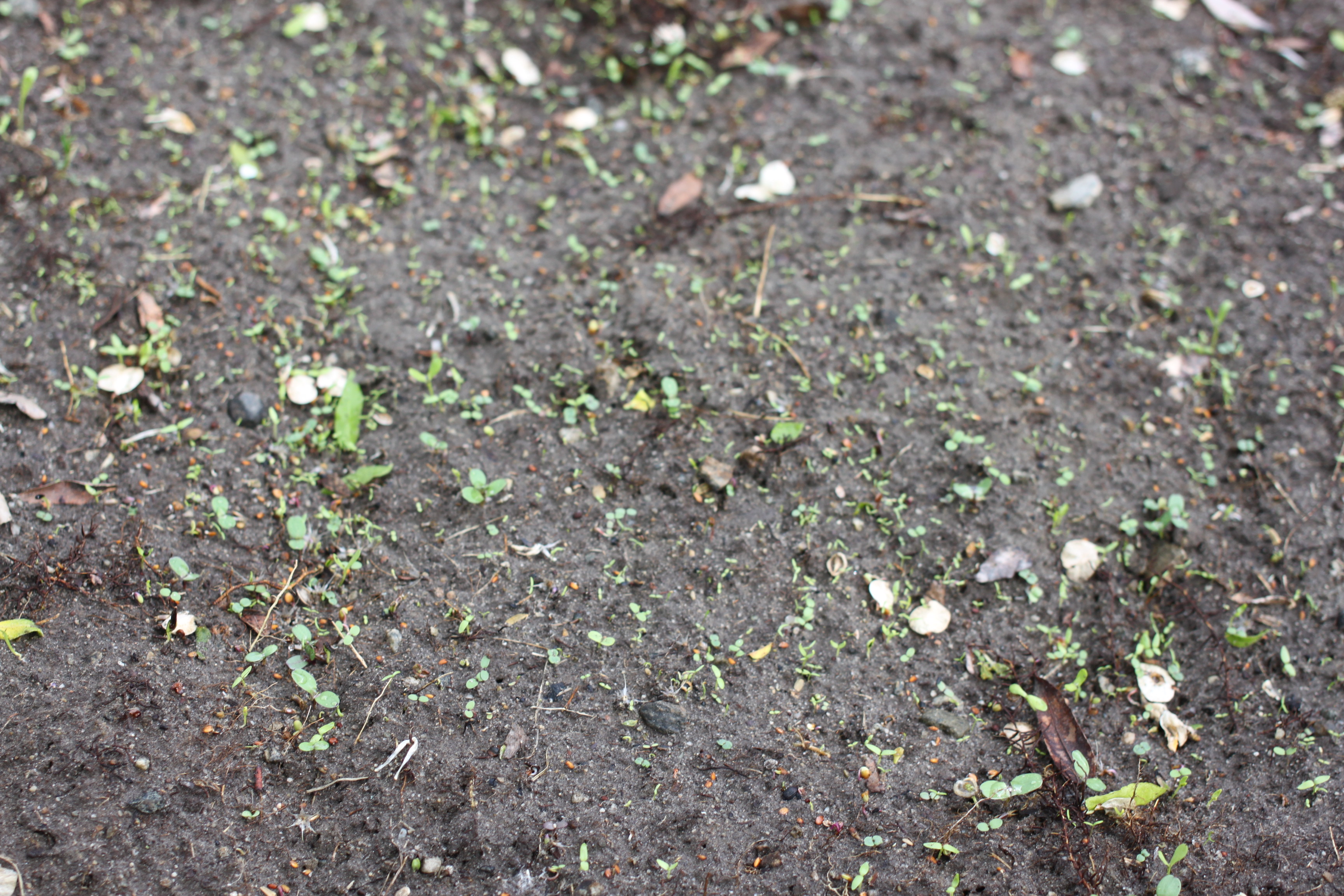
Week 1

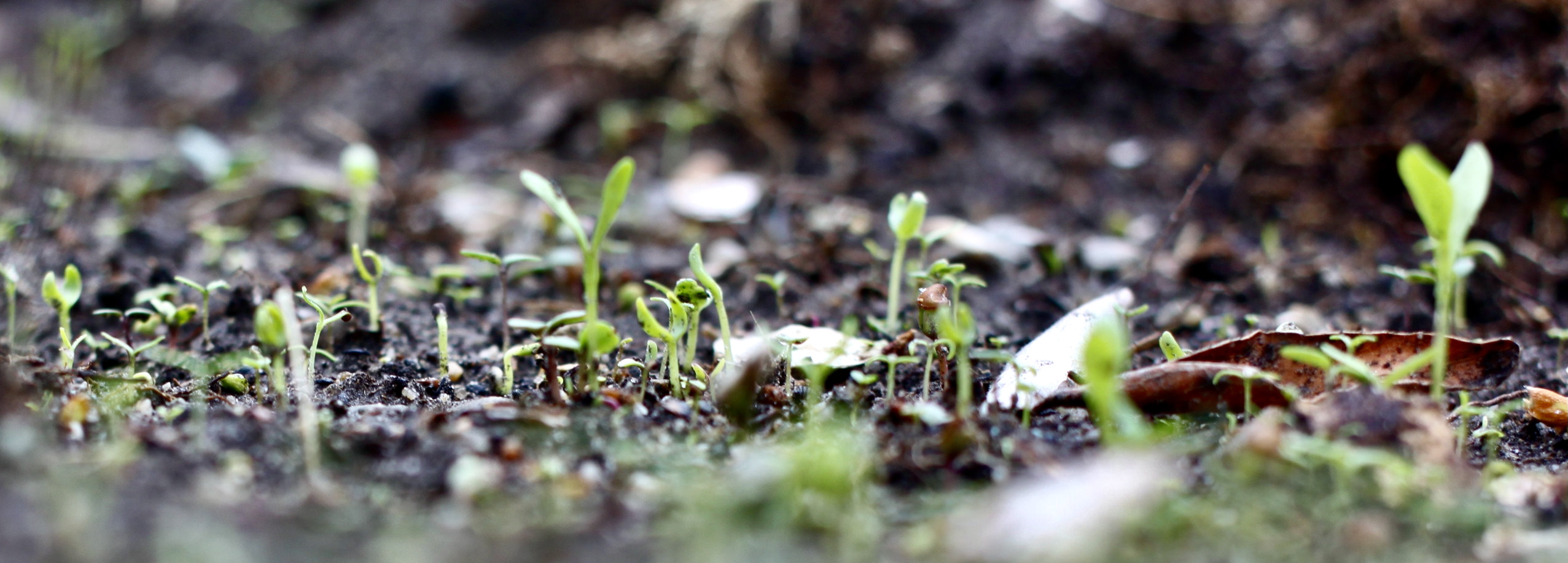
It only took a week for tiny shoots to emerge.

Week 2

Week 3

Week 4

Week 5 and 6

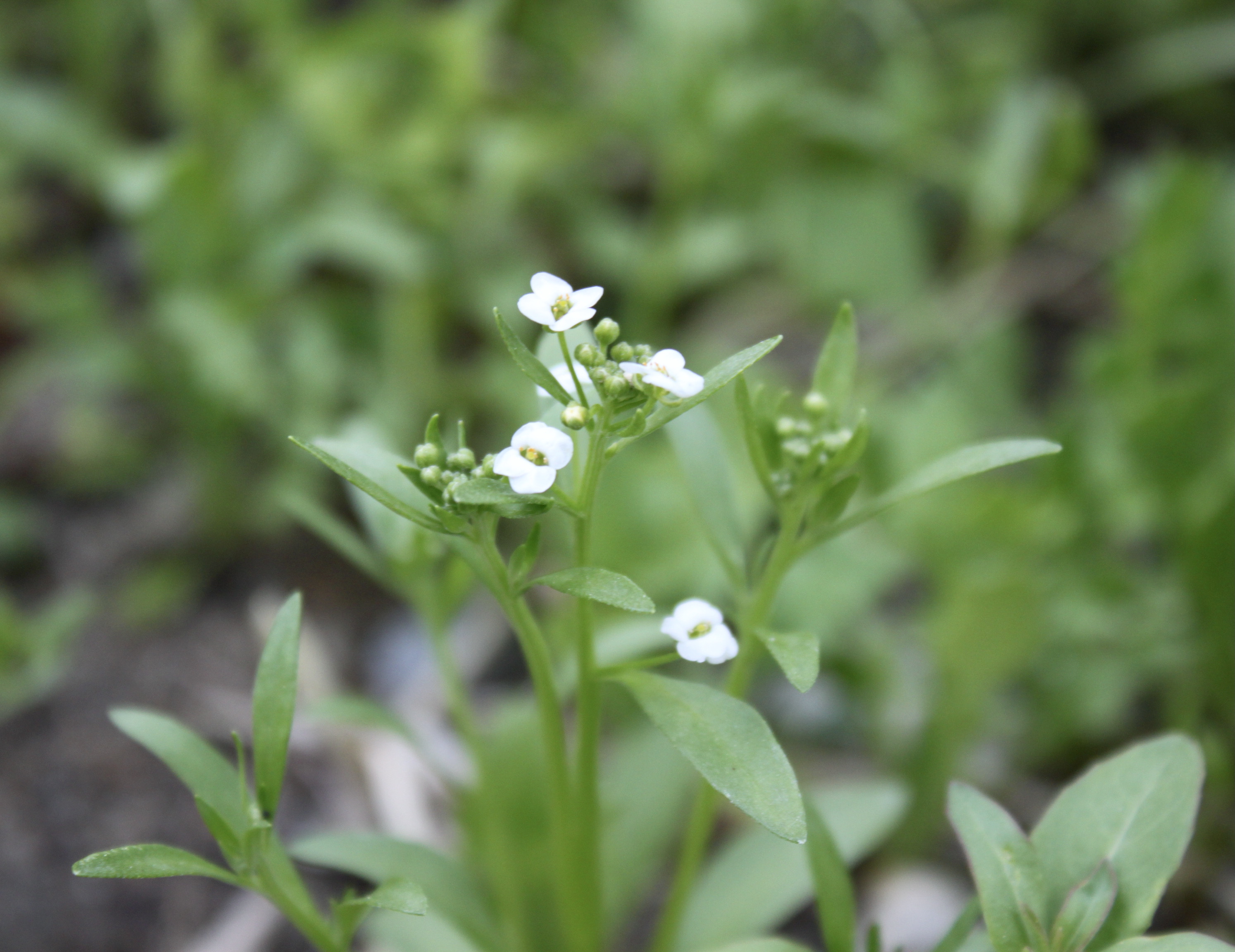
Flowers!

Week 7

Chinese houses

Week 8

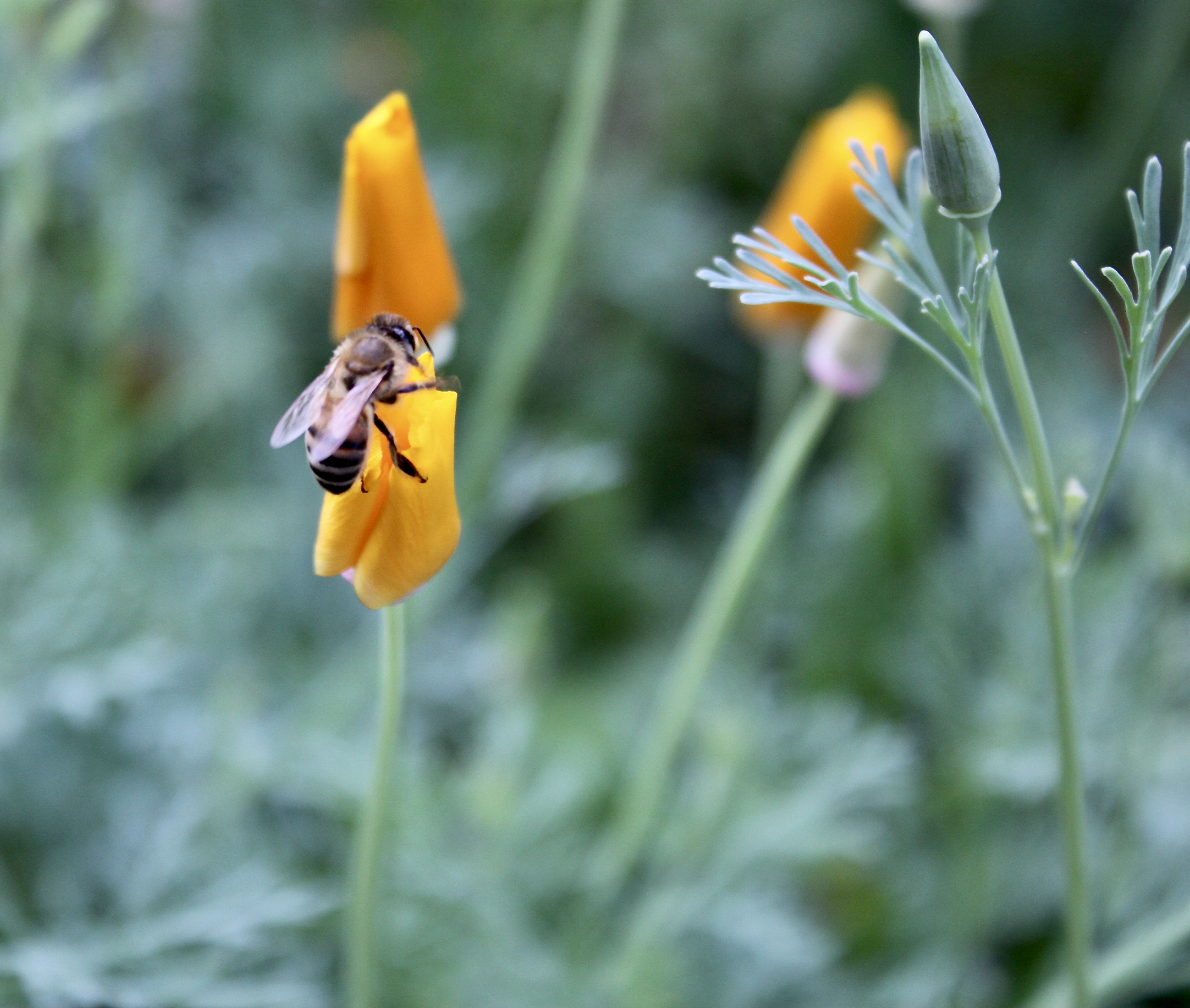
Our bees are getting happier and happier

Week 9

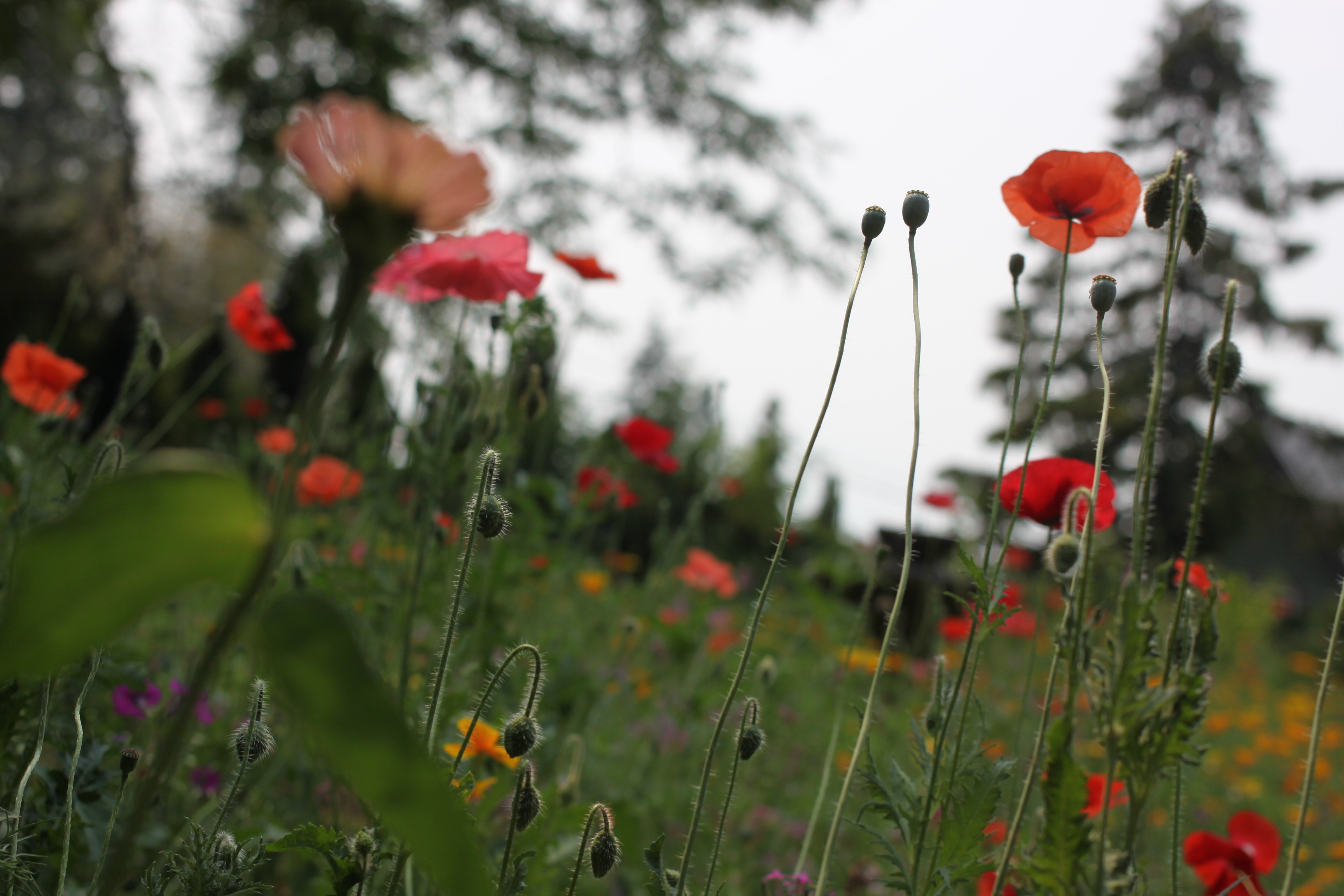
Poppies are making an appearance
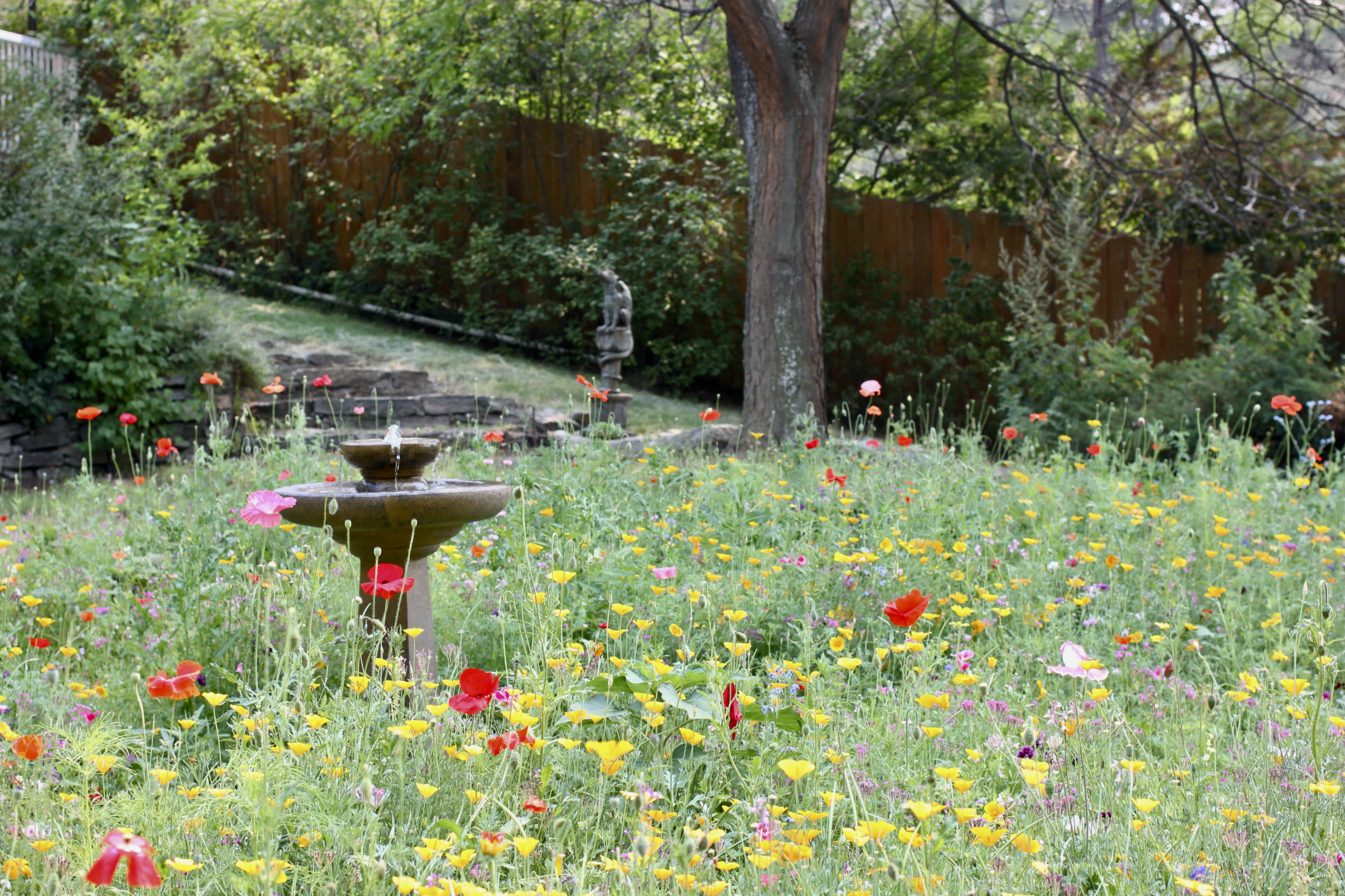
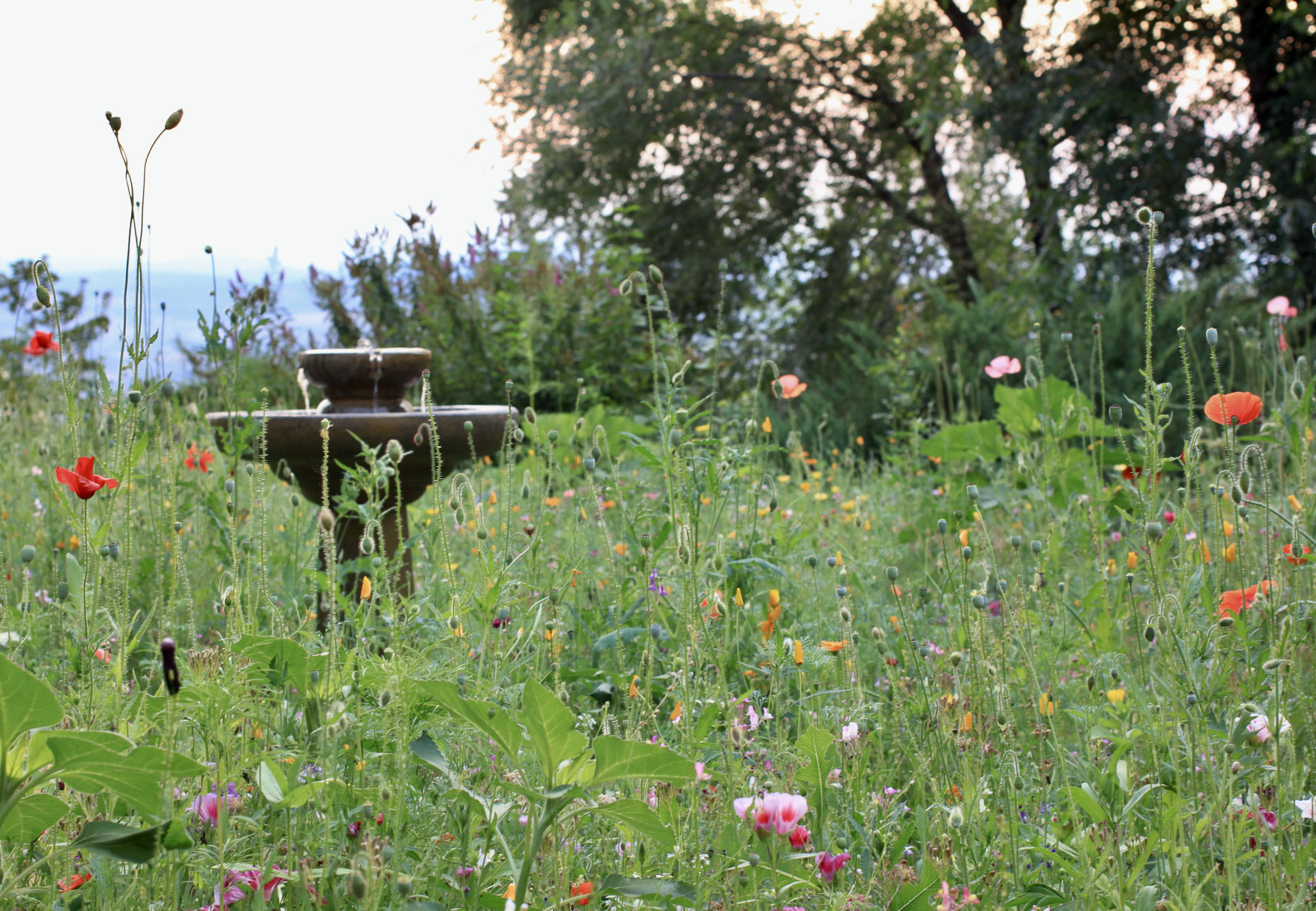
We had to add some art
and a fountain for the birds

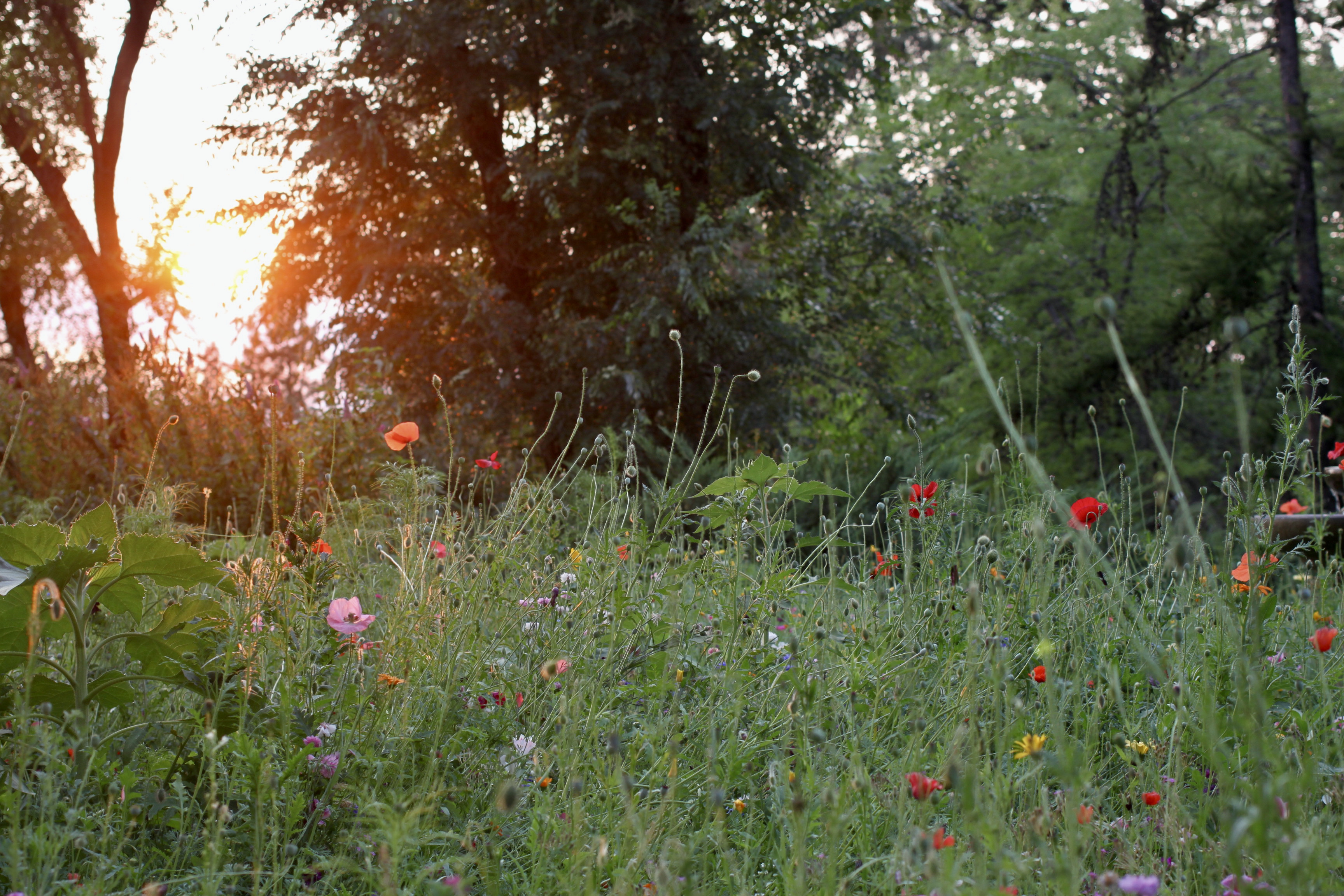
Week 10

When is the last time you sat having a coffee and experienced your lawn for an hour? Our meadow is alive with scents and colour and insect and bird activity. As a gardener I get a lot of pleasure out of a perennial bed planted up with 20 or 30 plants. Imagine two or three thousand flowers in an ever-changing tapestry of colour all ready for my camera lens. This is how a meadow evangelist is born.

Meadows offer a unique opportunity to help the planet from our own yards. They support many of the wild things that keep our ecosystems healthy and store carbon. Imagine sitting in a meadow and listening to the hummingbirds zooming from flower-to-flower, hear the background buzzing of the bees and watching swallowtail butterflies lighting here and there while the flora aroma engulfs you. Make room for some wildflowers, remove some or all of your unused lawn. If just a fraction of the existing lawns in Canada were turned into meadows, the ecological impact, especially on threatened pollinator species, would be immediately significant. All the preaching aside…it’s beautiful!

10 tips to keep your bits while swimming the chilly English Channel

The Challenge

After being part of a successful 6-person relay swim crossing of the English Channel (2016) with my team the Crazy Canucks I want to feel the butterflies and pebbles on an English beach one more time with sights set on France. I’m going back as half of a 2-person team. Sounds doable right? Half the Channel (we swam 50 km in our 2016 relay) and at my age in 2023 at 66 I feel like I will be biting off just enough to chew.

After some intensive research it looks like there is a good reason duos are quite rare. All the “ins” and “outs” of the one-hour shifts are a mind game and a shiver fest. All the helpful advice about ditching the duo for a solo aside, I have gathered 10 great tips to share from the some of the top open water swimmers in the world that will help anyone attempting a solo or relay open water challenge in chilly waters.

The Wonderful Mentors

Marilyn Korzekwa

In her 60s, named after famous Canadian swimmer Marilyn Bell, here are just a sampling of Dr. Korzekwa’s accomplishments:

  • 1st to complete Lake Ontario from south-to-north and north-to-south
  • 1st Canadian Triple Crown swimmer which includes the English Channel, Manhattan Island and Catalina Channel
  • Planning a second attempt of the first crossing of Lake Nipissing in 2020
Photo from Marilyn Korzekwa, Santa Barbara Channel

John Myatt

Ice king, John Myatt, is a father of three from Britain who has come back to swimming in the last decade after a long hiatus. Here is a sampler of John’s claims to fame:

  • Gold medal winner of the 45-49 age group at the Ice Swimming World Championship in Murmansk, Russia in 2019 (1,000 metres in zero degree water)
  • Half of a two-man English Channel team in 2015
  • Two-way, two-man English Channel relay in 2018 (22 hours, 49 minutes)
  • Currently planning a very challenging yet-to-be announced solo English Channel crossing
John Myatt on ice

Lynne Cox

American Lynne Cox is arguably the best cold water, long distance swimmer the world has ever seen. Her most famous swim was the 2.7 miles in the Bering Straits, 350 miles north of Anchorage, Alaska where the water temperature ranges from 38-42 degrees Fahrenheit. Perhaps the most incredible of cold water swims, her 2 hours, 16 minutes from Little Diomede (USA) to Big Diomede (USSR) astonished the physiologists who were monitoring her swim. It marked one of the coldest swims ever completed.

Lynne Cox
  1. Staying Warm

Warming up is tough. Go below, get dry and in a sleeping bag and drink lots of hot calories. Bring at least three sleeping bags per person in case they get damp. Buy them cheap in England and throw them out. Forget grease, just enough Vaseline to prevent rubbing. Grease will keep you clammy in your sleeping bag. Bring lots of swim suits so you can get in a dry one. Maybe a hair dryer if you’ve got electricity on board. Cut your hair short so it dries fast. You may need one support staff dedicated to keeping you in hot food and drink. — Marilyn Korzekwa. (Hard core Marilyn re cutting your hair…my hair is short but my partner Jan is in the process of growing her’s long…)

2. Acclimatize to the cold

I would definitely acclimatise to the cold as the thing is with a two person relay your not really fully recovered or warm going back in and that did take its toll. My top tip would be to build up to eventually swimming 6 x 1 hour with 30 minute breaks and feeds as when you get that extra half hour on the boat it will be amazing and you’ll enjoy your swim alot more and have the confidence knowing you have done it virtually all in training. — John Myatt

3. Trust your partner

As your a two-person team you will definitely want that trust in each other on the day knowing you have done all the hard work. — John Myatt. (Here is where keeping your bits comes in. Jan and I know that if either of us wants to call it quits the other will be strongly discouraging this idea. Just having someone counting on you can make all the difference when the chips are down.)

One plus one equals more than two

4. Don’t let age hold you back

I think you don’t need to be limited in your thinking by your chronological age. I think it’s great to tackle these swims at any age. If you’ve done the preparation and you are in shape it comes down to your mental fortitude. — Lynne Cox (I do think there are some concessions you need to make in your training which should include good rest days that will help in recovery. I will be 66, Jan will be 61.)

5. What to eat and when

All of your feeding can be on board during your one-hour off. Eat whatever you like. Hot chocolate, hot Maxim, hot coffee, latte, Perpetuem (a Hammer nutrition product, comes in two flavours that I particularly like- orange vanilla and coffee latte), tea with lots of honey or sugar, soup. I find pb and jam sandwiches easy to digest. Chocolates, eclairs, cake, etc. Potato chips are good for nausea. — Marilyn Korzekwa. We didn’t feed in the water during our hourly swims even when doing the two- way, I don’t think there is a need as you can get more nutrition down you on your hour out of the water. — John Myatt

The Channel was fickle during our 2016 swim. We had periods of relative calm but strong winds and waves nearing France.

6. Curb your enthusiasm

In January 2017 I was smashing out 14k on a Monday in the pool feeling like I was invincible and with in a short space of time I developed three major shoulder problems that lasted for 18 months, it was a hard path to my start line but I got there in one piece by changing my stroke and training habits and respecting that sometimes less is more, your body needs just as much rest as training, well in fact a whole lot more rest, never neglect that. — John Myatt

7. Fat or fast

The general answer to, “Should I put on weight to swim in cold water?” is that if you are very slim you better be fast. If you are a slower swimmer a little extra padding will help to keep you warm. It is also universally advised to do lots and lots of training in cold water. Another expression I’ve hear is “eat your wetsuit” or add a bit of jiggle to replace the insulation your wetsuit provides. With our June swim window, Okanagan Lake will be suitably chilly in the spring, even colder than the Channel, which will be ideal. (Jan doesn’t know it yet but I think we will be dipping in the lake (with wetsuits) all winter the season before our swim.)

8. Train smart

You should do a trial 34 k swim of Lake Okanagan in late May. It will work out the kinks, help you learn what you like, refine your schedule and give you immeasurable confidence. By April, you should be each be swimming 20 k a week. — Marilyn Korzekwa

Inevitably it’s all about making it to the start line in one piece, if you get any niggles ease back and seek a way to deal with it, either through physio stroke analysis etc, you just have to protect yourself and not force it and it will come with consistency. — John Myatt

Train in all types of weather and include some night swims, I would add.

9. Don’t fear the jellies

When I was swimming half way back from France on our second leg the light was shining down in the water and I could see the purple/ blue hues from the jellyfish bioluminescence and it was the most wonderful sight I have ever seen, the stings were nothing, a lot less than a stinging nettle. The culmination of the cold 11c water at night and the stings were the perfect tonic in waking me up and getting me to the finish. — John Myatt (Sounds a bit hard core John! I did get stung on our six-person relay and although it hurt at the time a little vinegar poured on the sting helped immediately. Although unpleasant, the jellies are a lot less scary than sharks which we thought a lot about on our Catalina Channel relay…)

10. Enjoy the ride

It’s all about the hours and hours of training and the camaraderie that brings. Once on the Viking Princess and out there in the Channel, It’s also about trying to take in the beauty and not letting the enormity of the task override the possibility of drinking it all in.

Spreading the love – Artisan jam vs. store bought

And a story of how not to make money…

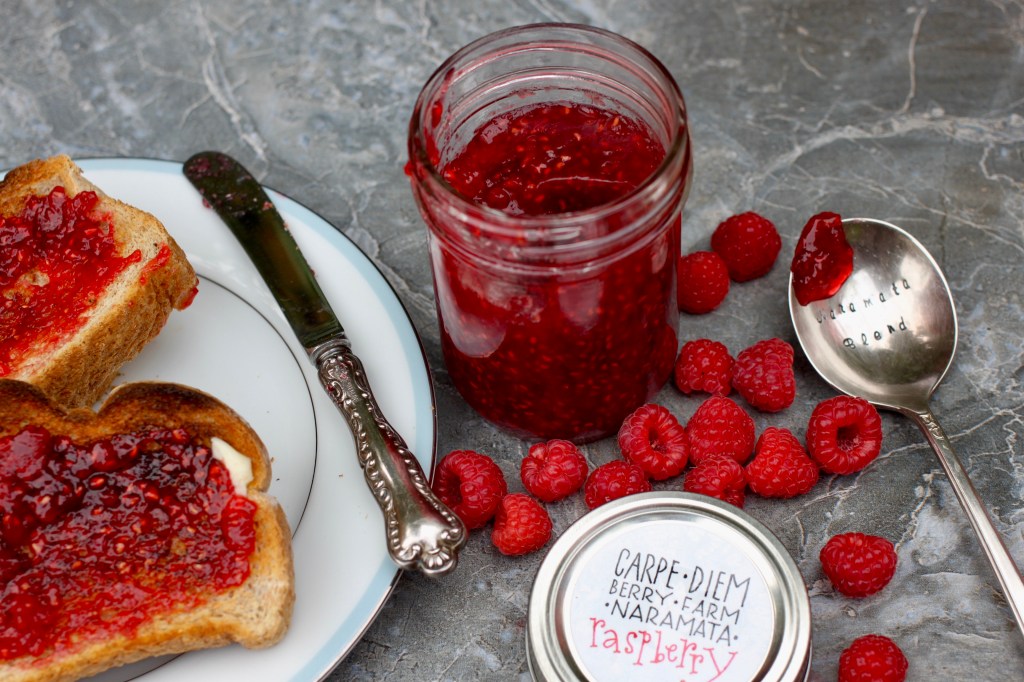
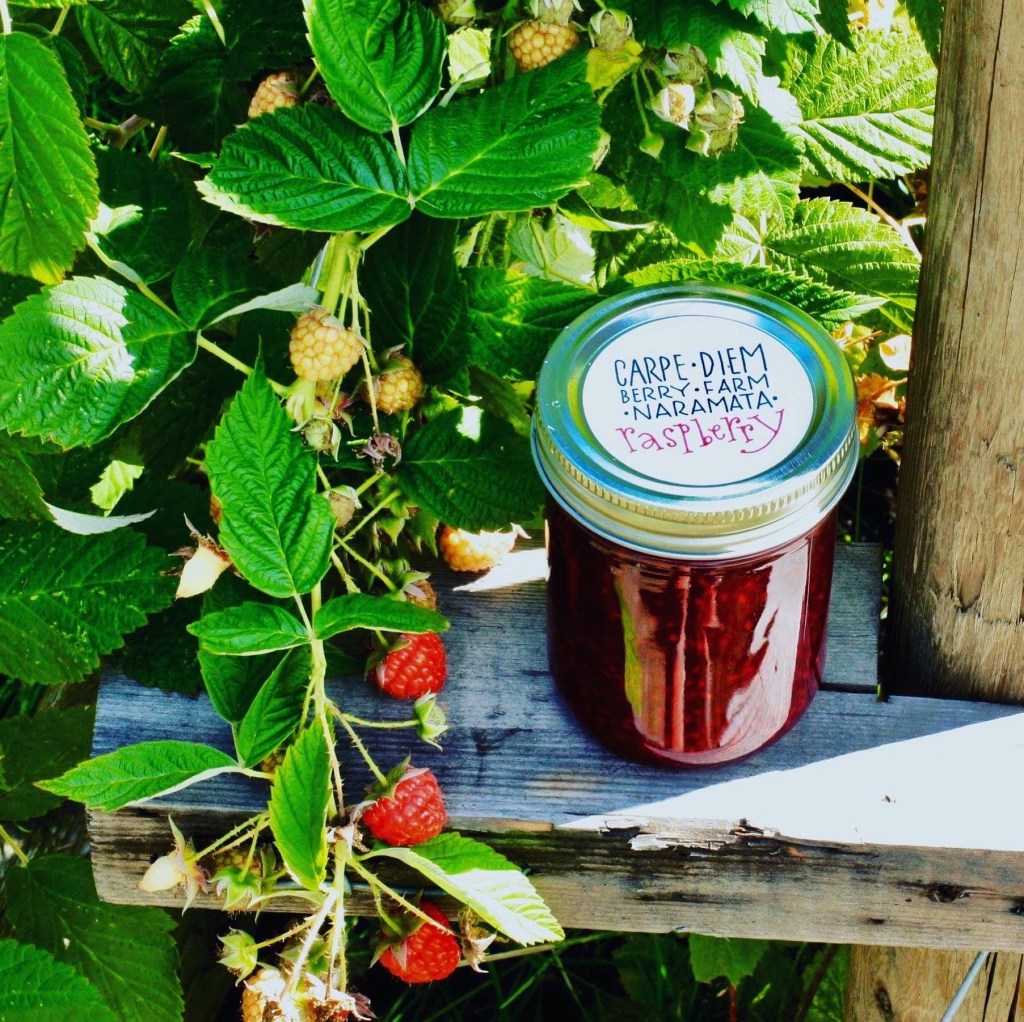
Raspberry jam from our farm-picked raspberries. From farm to jar in one day with only four ingredients.

Jam is a treat and although made from fresh berries it’s hard to argue that it is “healthy” as sugar is an important ingredient. If you are going to indulge yourself a bit, jam made from organic berries picked at their peak, pure cane sugar, freshly-squeezed lemon juice and fruit pectin is better for you than store-bought brands and you sure as heck can taste the difference.

Do you ever get a chemical after taste from store-bought jam or a gummy, overly sweet taste?

Fruit, never mind the raspberries you think you are buying, is often not even the first ingredient in store-bought jam. Look out for ingredients such fruit syrup (concentrated juices from less expensive fruit such as apples, pears or pineapples), high fructose corn syrup which is cheaper than pure cane sugar (now this is an ingredient you should avoid at all costs), natural flavours (which can be a whole lot of things that have nothing to do with raspberries) and citric acid which is made in a lab to substitute for lemon juice.

We grow our raspberries with a whole lot of care, no pesticides and only organic fertilizers.

I will let you in a little secret. I make absolutely no profit and do not even cover my costs when making jam with raspberries from our farm and selling it for $7 (Canadian) a jar. Hence…spreading the love.

I haven’t been able to find new jars that sell for less than $1 each

The jars, lids and rings cost about $1 each although to find that price now I have to search for sales as these prices go up every year.

I love my labels designed by calligrapher http://Kathyguthrie.com and printed by http://Stickerapp.com

My labels, not including the one-time design cost, are about 25 cents each. (They would be slightly cheaper if I ordered in larger quantities.)

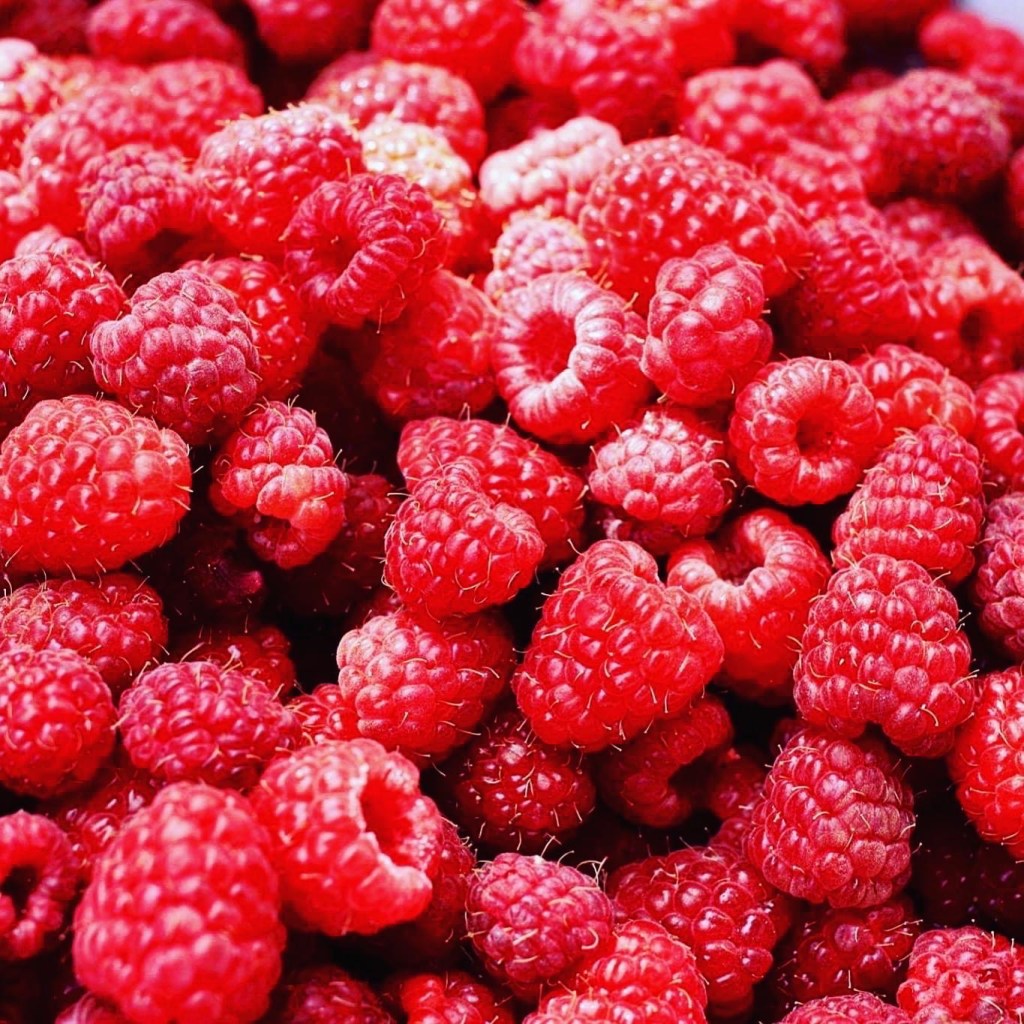
Each jar has a pint of fresh-picked organic raspberries from our farm which I would sell for $5.

The fresh lemon juice is also an expensive ingredient.

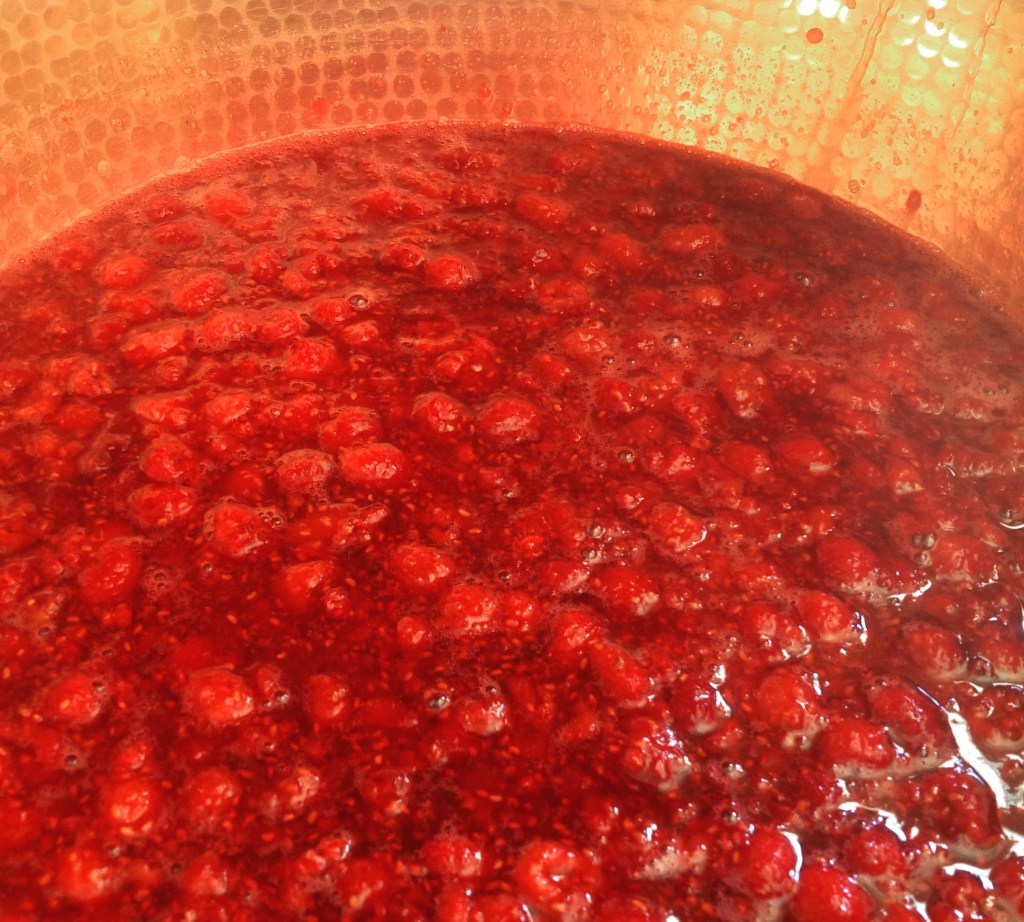
I make my jam in a copper jam pan I ordered from France. The jam heats more quickly reducing cooking time and preserving more flavour in the copper pan.

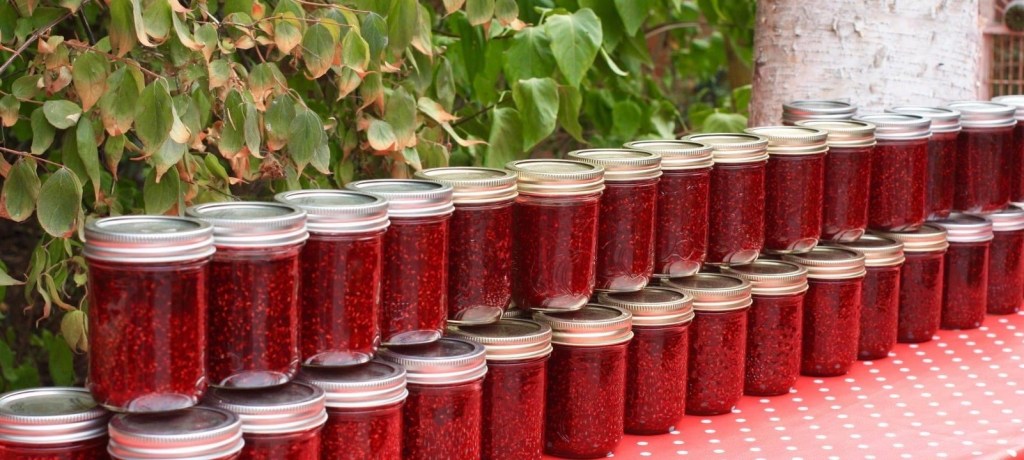
So with the cost of the ingredients, jars and labels adding up to my sale price I have not yet added in labour which includes sterilizing everything, meticulously cleaning work surfaces, making multiple small batches to control the quality and electricity to make the jam and boil the water in the canner. In addition time is spent marketing and distributing the jam which I often deliver.

Some batches of jam are made even more special with some artisan vodka. Get this…This Slowpoke Vodka made by http://Legenddistilling.com is made from our raspberries so the jam is like raspberry flavour squared.

Why do I make and sell jam? I love making jam. The smell of a simmering pan of raspberry jam is my favourite scent in the world. I like it that we have developed a bit of a following (and a wait list) and local bed and breakfasts, lodges and neighbours appreciate how great it tastes and have an inkling of what goes into making it. As cheesy as it sounds, it truly feels like spreading the love.

“It is the sun shining on the rain and the rain falling on the sunshine…” The Secret Garden

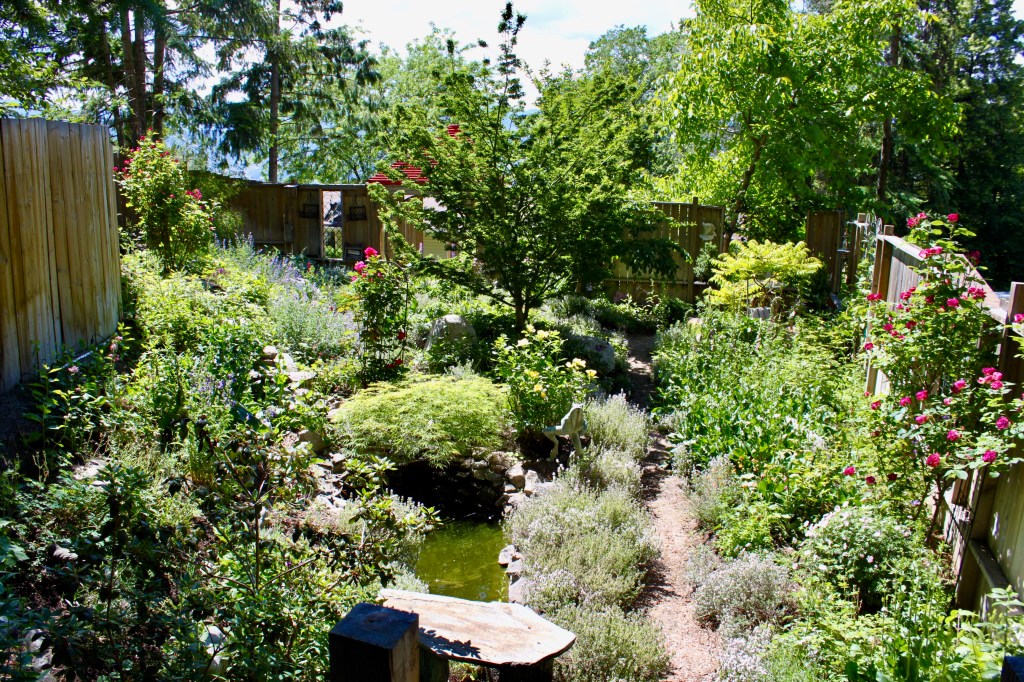
It’s been unusual. A cooler and wetter spring…a pandemic that kept us a home. Our secret garden has been the beneficiary. Here is a bit of a photo essay on the effects of perfect growing conditions and lots of attention in our Naramata, British Columbia, Canada garden on the summer solstice.

“I am sure there is Magic in everything, only we have not sense enough to get hold of it and make it do things for us.” The Secret Garden

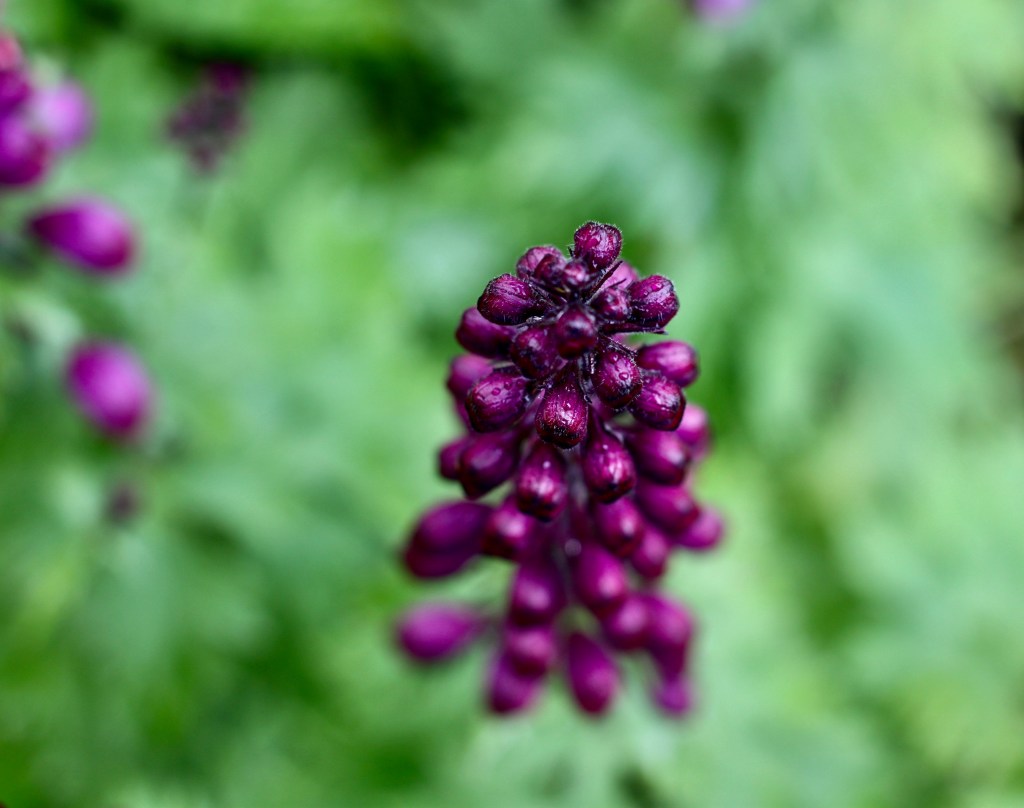
The purples seem more purple this year…

The pinks more pink…

And we’ve had time to sit and enjoy it all unfolding.

With our pals who are allowed in from time to time…

Just outside the garden walls is our raspberry farm just days away from harvest.

The farm has never looked so tidy. One hour-long spray with round-up would have dealt with all the grass and weeds that invaded the rows but we don’t spray or use chemicals so it was a 160-hour job completed over four months. On hands and knees with a garden fork… It should be easier to maintain going forward with minor attention. It looks great but more importantly the raspberry roots now have less competition for nutrients, water and space. It’s going to be a bumper crop.

8 remarkable women to read about whose stories will enthral, move and inspire

These women have gone through some stuff you and I likely never will but we can go along for eight amazing rides and if you are lucky arrive at the end a bit braver, stronger, more self-aware. You might just tackle a Reine de Saba, Julia’s first French cake or swim the English Channel (with a team) like I did. Two of these fine women actually did change my life. Your reactions may not be as dramatic but I guarantee their stories will have an impact.

  1. Beryl Markham

“Around Beryl life was never dull. Like a comet passing through the firmament she lit up all around her. None who came in contact with her could fail to recognize the genius of a truly remarkable person.”

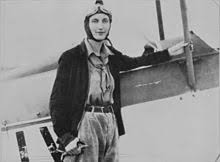
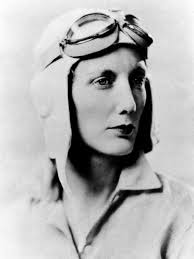
Everyone has heard about the American aviator, Amelia Earhart, the first woman to fly solo across the Atlantic, but Beryl Markham was pretty amazing and much less feted. She made history in 1936 as the first person ever to fly the Atlantic solo, in the other direction, from England to North America. Check out West With the Night and Straight on Till Morning by Markham’s biographer Mary S. Lovell. Or for a compelling recent historical fiction memoir I recommend, Circling the Sun by Paula McClain. Much of her life was spent flying in Africa and spending some reading time in her company will make you feel like an adventurer and explorer in the days when the world seemed a much bigger place.

2. Anne Morrow Lindbergh

Anne was the author of more than two dozen books but she is best known for two dramatic experiences when she was in her 20’s. One was blissful, one anguished. There were reflected in the title of a volume of her diaries, Hour of Gold, Hour of Lead. She met and married Charles Lindbergh, who was the first to fly solo across the Atlantic making him at the time, the most famous man in the world. The second experience came on the evening of March 1, 1932 where the Lindbergh were at home with their 20-month old son, Charles Jr. and a nurse, Betty Gow. The nurse looked in now and then on Charlie as he slept in his crib.

“At 10 Betty went in to the baby, shut the window, then lit the electric stove, then turned to the bed; it was empty, and the sides still up,” Anne wrote. The Lindberghs were soon enveloped in the horror of the kidnapping, the discovery of the baby’s body 10 weeks later and the long investigation to catch the kidnappers.

I poured through the five volumes of her diaries that chronicle the birth of the paparazzi that hounded the famous couple and her own flying exploits. She learned to navigate, to operate a radio and to pilot a plane. In 1930 she became the first woman to get a glider pilot’s license in the US. That same year she was co-pilot and navigator when her husband broke the transatlantic speed record. Her first book, North to the Orient is a fun historical read as well although I loved the diaries.

Her life and love, was not without controversy. Lindbergh campaigned to keep America out of World War II. He also gave a speech in Iowa in 1941 in which he warned Jews of retribution for being among the leading “war agitators”. In her diary volume called War Within and Without, she said she experienced profound feelings of grief over what her husband had said.

In her later years, Anne discovered that Charles’ long trips away from home gave him the opportunity to have two other wives and more children… the plot thickens.

I loved the diaries for the history, her vulnerability, strength and mundane things like the enjoyment of the gardens she cultivated in England and France. Lindbergh fostered his wife’s feminism and in helping her to stand on her own two feet, created so much independent that it almost separated them. They are fascinating reading. I started with one of the diaries and haunted our used book store until I had read all five.

3. Lynne Cox

A pioneer of open water swimming, the description of Lynne Cox’s story in Swimming to Antarctica: Tales of a Long-Distance Swimmer by USA Today cracks me up. “What emerges here is an athlete whose determination is so fierce that it seems almost exotic. She is fit. She is focused. She is Lance Armstrong with body fat.”
Here are some of her amazing achievements – At the age of 16 she set a new world record for an English Channel swim. She was the first to swim the Strait of Magellan. She narrowly escaped a shark attack off the Cape of Good Hope and was cheered across the 20-mile Cook Strait of New Zealand by dolphins. She swam the Bering Straight and went for a mile long dip in the Antarctic, dodging icebergs.

A lover of adventure non-fiction, I’ve found many of the stories gripping but the telling of the tales a bit uneven. Many adventurers are better at clinging to mountains or running white water than they are re-telling their tale. Not so Lynne. I love her writing. She is an extraordinary athlete in the niche sport that has captured my passion but she also has the gift of describing her efforts so well that even non-swimmers can almost feel the cold water and absorb the experience.

I also recommend Grayson and her newest book, Swimming in the Sink.

Lynne gave our team advice when I asked her about comparing the English Channel (which our Crazy Canuck’s team did in 2016) to the Catalina Channel which we knocked off in 2019. She was right and I am her biggest fan.

4. Julia Child

Here is where you may think I’ve drifted off theme from my daring-does women. But far from it, Julia paved a remarkably courageous, strong and pioneering path of her own that changed the face of cookbook writing and cooking shows on what was then a new medium, television.

Start with My Life in France by Julia and if you are blown away by her humour and spirit as I was plunge in deeper with biographies. Dearie by Bob Spitz and Appetite for Life by Noel Riley Fitch will help fill your hunger for more joie de vivre and Julia.

Once you understand her purpose and the years and drive it took to bring the pleasure of French cooking to America, then it’s time to crack open Mastering the Art of French Cooking Volumes I and II and try your hand at some of the recipes. I highly recommend Boeuf Bourguignon, her French bread recipe (although it is 21 pages long) and finish off with a chocolate cake to end all chocolate cakes, the Reine de Saba.

5. Clementine Churchill

Her life story is so much more than the woman behind the man kind of tale. A great way to plunge into the life of Clementine is through her own words. Winston and Clementine, The Personal Letters of the Churchills edited by their daughter Mary Soames is a fascinating look at more than 60 years of the famous couple’s life. If you are into history it’s great. It’s also very romantic. Their loving relationship unfolds in all its sadness, tenderness and joy. It’s a real partnership and of course we all know Winston can write. Well, it turns out Clementine can too.

Here is just a little snippet:

3 August 1929

“My darling one,

It was not without some melancholy twinges that I watched the figures of Diana and Sarah disappearing on the quay. All departures from home – even on pleasure are sad. The vessel drifts away from the shore and an ever-widening gulf opens between one and the citadel of one’s life and soul. But most of all I was distressed to think of you being lonely and unhappy and left behind.”

6. Isak Dinesen

The cover of my 1938 US First Edition

Born in 1885, Isak Dinesen was the pen name for Baroness Karen von Blixen, and the period of her life that most fascinates is her time in Ngong Hills in Kenya. Coles Notes version… she ran a coffee plantation, caught syphilis from her husband, returned to Denmark for the cure, came back to Africa and had a long-term affair with Denys Finch Hatton.

During this time in Africa she went on safari, flew with Finch Hatton in an open cockpit plane over stunning scenery and recorded life in in poetic prose. My favourite lines include the first of the book, “I had a farm in Africa, at the foot of the Ngong Hills. The Equator runs across these highlands, a hundred miles to the North, and the farm lay at an altitude of over six thousand feet. In the day-time you felt that you’d got high up, near to the sun, but the early mornings and evenings were limpid and restful, and the nights were cold.”

And these, which send shivers up my spine, especially when spoken by Meryl Streep in the movie version of Dinesens’ book titled Out of Africa…

“If I know a song of Africa, of the giraffe and the African new moon lying on her back, of the plows in the fields and the sweaty faces of the coffee pickers, does Africa know a song of me? Will the air over the plain quiver with a color that I have had on, or the children invent a game in which my name is, or the full moon throw a shadow over the gravel of the drive that was like me, or will the eagles of the Ngong Hills look out for me?” 

And this gem…

“Perhaps he knew, as I did not, that the Earth was made round so that we would not see too far down the road.” 

Wow, right?

Karen was one interesting lady. Good thing she could write so we could still learn about her.

7. Lucy Maude Montgomery

Here I’m diverging again from my theme. It’s not the author that inspires as much as the ahead-of-her-time character of Anne Shirley. But of course it’s the author Lucy Maude Montgomery that gave us Anne. The first in the series of books is of course Anne Of Green Gables, written in 1908, yup 1908.

Written for all ages, it has been considered a classic children’s novel since the mid-twentieth century. Set in the late 19th century, the novel recounts the adventures of Anne Shirley an 11-year-old orphan girl, who is mistakenly sent to two middle-aged siblings, Matthew and Marilla Cuthbert, who had originally intended to  adopt  a boy to help them on their farm in the fictional town of Avonlea on  Prince Edward Island in Canada. The novel recounts how Anne makes her way through life with the Cuthberts, in school, and within the town.

Since its publication, Anne of Green Gables has been translated into at least 36 languages and has sold more than 50 million copies, making it one of the best selling books worldwide. Montgomery wrote numerous sequels, and since her death, another sequel has been published, as well as an authorized prequel. The original book is taught to students around the world.

So what’s the big deal?

Anne is timeless, particularly for young girls. She’s smart and independent. The fact that she is very opinionated, strong-minded, and doesn’t just shut up and meekly do what she’s told puts her outside of her own time.

I have a lovely collection of old editions of the Anne stories and love to dip into them.

“I am frankly in literature to make a living out of it,” Montgomery said. The P.E.I. native did just that and left inspiration for many many girls along the way.

8. Diane Stuemer

The Voyage of the Northern Magic, A Family Odyssey is about a four-year voyage around the world told compellingly by the mum and wife Diane Stuemer. Diane and her husband Herbert, entering middle age, with a comfortable home and three boys under 12 did what many of us muse about but of course never do… they sold everything and took their family to circumnavigate the globe in a 40-year-old boat.

The book is gripping. Storms at sea, pirates, waterspouts, lightning strikes, broken water pumps, masts and radios and 34 countries and 35,000 nautical miles. It’s all made more poignant because of Diane’s health. The trip was started following her brush with cancer and she dies at the age of 43 not long after the Northern Magic pulled into port for the last time.

Diane, emotions brimming at the end of the family’s voyage.

Embarking on a crazy adventure solo is one thing, bringing your family along for the ride is something different. Reading about how they managed and grew as a unit from a mother’s point of view is inspiring as are all the friendships, connections and charity work they poured themselves into along the way. Weirdly, one of the books saddest moments for me was when the stray cat they picked up along the voyage ended up overboard.

Over to you. I would love to know if you take up any of my suggestions and what you think.

Blog at WordPress.com.

Up ↑